

Specialized Whirlpool Appliance Repair in San Francisco
Mon–Sat: 8:00 AM – 7:00 PM
A chest freezer that stays soft or runs without freezing may be fighting its location, its lid seal or a failing cooling part. Start with the room, the power and the lid.
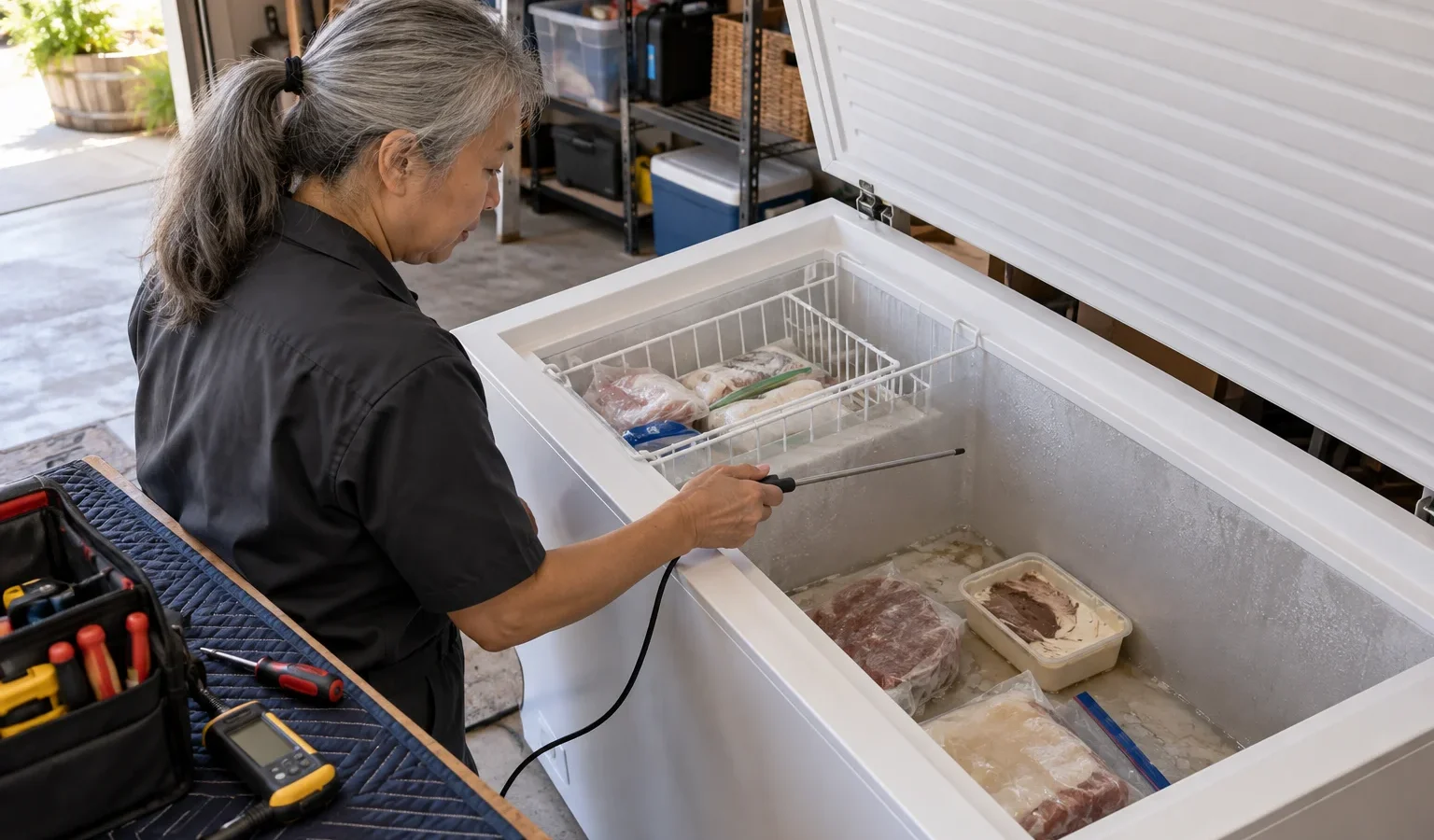
A chest freezer is built to be forgotten. It sits in a garage, a basement storage room or a utility closet and quietly keeps a season of food frozen. That is also why a failure goes unnoticed: you lift the lid for a bag of vegetables and find the contents soft, or you notice frost where there was none. This article covers what usually causes a chest freezer to stop freezing and which checks are safe to do yourself.
Chest freezers like a space with room to breathe. A freezer jammed against a garage wall, buried behind boxes or tucked into a closet with no airflow cannot shed heat, and the compressor runs longer to compensate. In San Francisco, garages and basements are cool most of the year, which helps, but a freezer next to a water heater, a furnace or a sunny window works against itself. A freezer on an uneven floor can also sit with its lid slightly off, which defeats the seal.
If the freezer is in an unheated space that gets very cold, some units struggle to cycle properly in that environment. If it is in a space with heat sources, it may be overworked. Either way, mention the location when you request service.
Lid gasket. A seal that has flattened, split or collected debris lets room air in. You will see frost patches near the gasket line and feel warmth at the rim.
Thermostat or temperature control. If the control reads wrongly, the freezer stops cooling early or never starts. A dial that was bumped is the easy cause. A failed control is a diagnosis.
Compressor start parts. A freezer that clicks and does not start, or hums briefly and stops, may have a start component problem. Do not try to test or replace those parts yourself.
Condenser surfaces. Dust on the cooling surfaces, usually around the lower back or along the outside of the cabinet, slows heat release. Some chest freezers have the cooling surface along the cabinet walls, so the location checks matter.
Sealed system. A leak or a failed compressor ends cooling for good. That is the least common cause and only a trained technician should handle it.
Keep the lid closed as much as possible. A chest freezer holds cold well while closed, and its contents help each other stay frozen. If you have another freezer or a cooler with ice, move the most valuable items there. Food that has thawed and then refrozen, or stayed warm for an unknown time, should not be trusted. When in doubt, discard it. If there is meltwater, mop it up and keep it away from outlets and cords.
Request a visit when power, the lid seal and the setting all look right and the freezer still does not freeze, when you hear clicking without running, when frost builds quickly, or when the compressor runs without cooling. Please tell us where the freezer is kept, how full it is and when you first noticed the problem. The model number is usually on the freezer’s inner wall; have it ready if you can reach it safely.
A visit starts with diagnosis before repair, a written estimate and your approval before work begins. Read about Whirlpool freezer repair and see the Whirlpool freezers overview. If you own a chest model such as the Whirlpool WZC3209LW, its model page lists what is on record. A refrigerator with the same symptom is covered in this not cooling article.
Heat may not be leaving, the lid may not seal, or the cooling circuit may be losing capacity. Location and gasket checks come first; after that, a technician needs to test the cooling parts.
Yes. Poor airflow, nearby heat sources, damp conditions and a tripping GFCI outlet are common in garages. A cramped corner makes the compressor work harder.
Some frost is expected in a chest freezer. A thick layer, or frost clustered along the lid rim, suggests warm air is getting in. Check the gasket and how the lid closes.
Not unless you are ready to relocate the food. Defrosting removes ice but does not fix the cause. If the freezer is not cooling, the food is better protected in a cooler with ice while you request service.
It is usually on a label on the inner wall, below the lid. Look for it near the top edge of the cabinet. If you cannot find it, describe the freezer’s shape and size.
Share a few details and we’ll confirm an appointment. Prefer to talk? Call us and we’ll help right away.