

Specialized Whirlpool Appliance Repair in San Francisco
Mon–Sat: 8:00 AM – 7:00 PM
Food going warm in a Whirlpool refrigerator can come from a blocked vent, a dirty condenser area, a defrost fault or a failing fan. Here is how to sort it out in order.
A refrigerator that has stopped keeping food cold usually gives a few clues before it gives up. The milk tastes off a day early, the freezer drawer feels soft, or the motor seems to run all afternoon without winning. In a San Francisco kitchen, where the refrigerator often sits in a tight alcove between cabinets or beside a wall heater, those clues are easy to miss until a shelf of groceries is already warm.
This article walks through what “not cooling” can mean on a Whirlpool refrigerator, which causes are most likely, what you can safely check yourself and when to stop and request a visit.
Cold air in a refrigerator is made in one place and moved to another. A sealed system produces the cold, an evaporator coil inside the freezer section carries it, and fans push that air through the freezer and down into the fresh-food compartment. A fault anywhere along that chain ends with the same complaint, which is why the symptom alone does not name the part.
Frost where it should not be. The defrost system melts frost off the evaporator coil on a schedule. When a heater, sensor or timer-type control fails, frost builds into a block and air cannot pass. You may see a wall of ice behind the freezer panel and hear a fan that sounds strained.
A fan that has stopped. There is a fan near the coil and usually another near the compressor at the bottom rear. If the first one fails, the freezer may stay cool for a while but the refrigerator section drifts warm. If the second one fails, the compressor area overheats and cooling weakens.
Dust on the condenser. Heat cannot leave, so the compressor works harder and cools less. This is the one cause where owner cleaning can help, as long as it stays outside the cabinet.
A control or sensor problem. A temperature sensor that reads wrongly can tell the refrigerator to stop cooling too early. A control that has lost its settings can do the same. These need testing with instruments, not guessing.
Sealed system trouble. A compressor that will not start, or a refrigerant leak, ends the cooling entirely. Nobody should touch the sealed refrigeration circuit except a trained technician, and it is the least common reason on the list.
If your refrigerator shows a power outage indicator after a building power interruption, the Whirlpool refrigerator PO code page explains what the indicator reports about the freezer contents. Give the unit time to settle after power returns before deciding that something is broken.
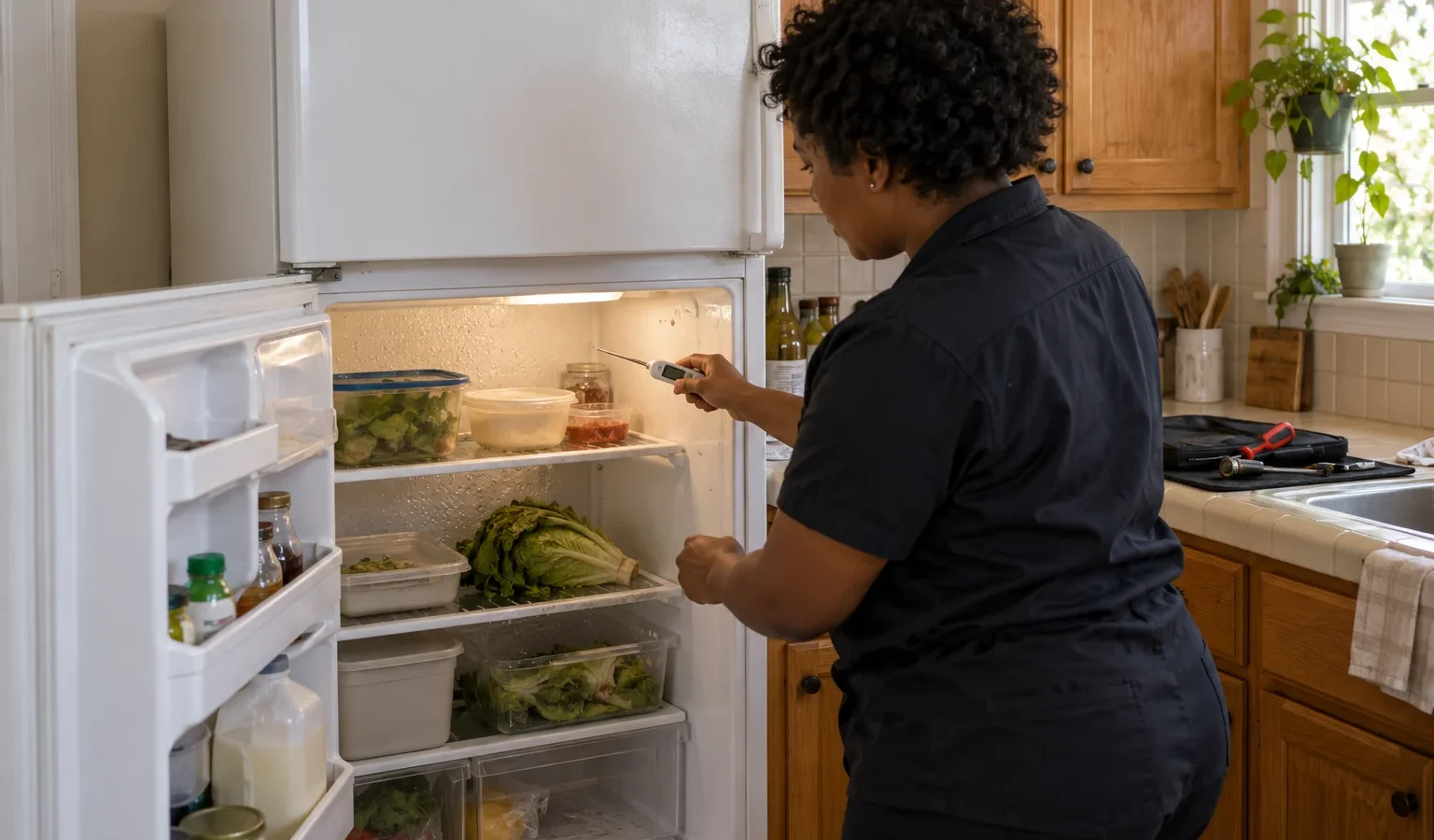
Keep the doors shut as much as you can. If the fresh-food side has warmed, move perishables to a cooler with ice, or to a neighbor’s refrigerator in a building where you have that kind of relationship. When food has been warm for a long stretch, or you are unsure how long, discard it rather than gamble.
A burning smell, smoke or sparking from the back of the refrigerator is a different situation. Unplug it, or switch off its breaker if you cannot reach the plug, and request service.
Book when the outside checks are done and the refrigerator is still warm, when you can see a sheet of frost behind the freezer wall, when the fan is silent or grinding, or when the compressor runs without cooling. Have the model number ready; on many refrigerators it is usually on the inside wall or the door frame. Tell the technician what you saw, which sounds you heard and what you already tried.
A visit begins with diagnosis before any repair, you receive a written estimate, and nothing is repaired without your approval. For the full list of what we handle on these units, see Whirlpool refrigerator repair and the Whirlpool refrigerators guide. If you own a bottom-freezer unit such as the Whirlpool WRFF3136SB, its model page lists what is on record for it.
Cold air is made in the freezer section and sent down into the fresh-food side. If the damper, the air passage or the circulating fan is not doing its job, the freezer can stay cold while the refrigerator warms up. A frosted evaporator is a common reason.
It can reduce cooling a great deal. Dust blocks the airflow that carries heat away, so the compressor runs longer and still falls behind. Cleaning the reachable outside grille area with the power off is a fair first step, but it does not fix a failed fan or defrost fault.
Unplugging lets frost melt, and cooling may return for a while, but if the defrost system failed the frost will build again. Treat a temporary recovery as a clue and mention it when you request a visit.
That depends on how warm it got and for how long, so there is no safe rule from the outside. If you are unsure, throw perishables away. Frozen food that still has ice crystals and has stayed frozen throughout is a different matter than food that thawed completely.
It helps. The model number lets a technician plan for the right parts and tells apart bottom-freezer, French-door, side-by-side and compact layouts. If you cannot find it, describe the layout and we will help you locate the label.
Share a few details and we’ll confirm an appointment. Prefer to talk? Call us and we’ll help right away.