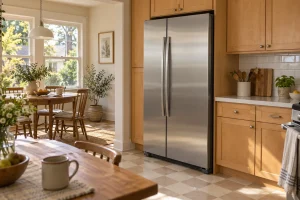
Refrigerators
Compact and bottom freezer Whirlpool refrigerators in San Francisco and the Bay Area: where to find the model label, common complaints, codes…

Specialized Whirlpool Appliance Repair in San Francisco
Mon–Sat: 8:00 AM – 7:00 PM
Bottom-freezer, French-door, side-by-side, top-freezer and compact Whirlpool refrigerators, diagnosed in your kitchen before any part is ordered.
A refrigerator is the one appliance that cannot take a day off, and in a San Francisco flat or in-law unit there is rarely a spare one waiting in the garage. When a Whirlpool refrigerator starts running warm, dripping onto the floor or humming without end, the useful question is which system has failed: cooling, defrost, water, airflow or controls. We start there, and we put the answer in writing before anything is repaired.
Complaints tend to fall into a few groups, and each group points toward a different part of the machine.
Cold air for the fresh-food compartment is usually moved from the freezer by a fan and metered through an air path. If that fan is slowed by frost, or the air path is packed with frost or food, the freezer stays cold while the shelves warm up. A technician checks the evaporator fan, the airflow passages and the control that regulates how much cold air gets through.
This points to the sealed cooling circuit, the condenser fan, a dirty condenser, a failed start component or a defrost problem that has frozen over the coil. Some of those are simple, and some are not. We separate them by testing, not by guessing at a part.
The common sources are a blocked defrost drain, a loose or cracked supply line to the ice maker or water dispenser, a worn inlet valve, or a filter housing that no longer seats correctly. Our post on a Whirlpool refrigerator leaking water walks through how to tell them apart.
No ice, small ice, ice that fuses into a block and a dispenser that trickles are usually water-path problems, though the ice maker module itself can fail. Read more in Whirlpool ice maker not making ice.
Rattling, buzzing and repeated clicking come from fans, from the compressor area, from a drain pan that has shifted, or from a start device cycling. Whirlpool refrigerator clicking noise explains which sounds are normal and which deserve a visit.
We begin with what you have seen: when it started, whether the freezer or the fresh-food side changed first, whether the sound or the leak is new. Then we read any code on the display, check the cabinet for frost patterns, listen to the fans and the compressor area, confirm that the doors seal, and test the components that match your symptom. After that you get a written estimate for the repair that fits what we found. If you decline, nothing is repaired.
Many Whirlpool refrigerators show a short code or a light on the control. Write down exactly what you see before you touch anything. Some entries in our library have a stated meaning. The PO power outage indicator means the refrigerator lost power and the freezer may have thawed, so check what is in there before you refreeze anything. The H2O light on bottom-freezer refrigerators is the water filter reminder, which comes on when the filter is due for replacement.
Several other entries, such as E1, F3E1 and F8E1, are listed with reset steps only and no stated cause. For those, the code is a starting point for the technician, not a verdict. Our Whirlpool refrigerator error codes post lists what is known.
Where and how the refrigerator is installed often explains the fault.
These are all outside-the-cabinet checks, and none needs a tool.
Do not remove back or interior panels, do not chip frost off the evaporator, and do not touch the sealed cooling lines. If food is at risk, move it to a cooler or a neighbor’s refrigerator while you wait.
Turn the refrigerator off at the breaker if you smell something burning, see sparks, or find water pooling near the outlet. Keep the doors closed once the power is off. If the freezer has partly thawed and refrozen, discard what looks or smells doubtful. A running appliance that is slowly losing its cold is usually safe to leave on while it waits for a visit.
Whirlpool makes many refrigerator layouts, and parts that look alike can differ between versions. The label usually sits on the inside wall of the fresh-food compartment, along the door frame or near the crisper drawers. A photo of it before the visit helps us bring the right parts for your cabinet. If you cannot find it, read how to find a Whirlpool model number.
Our library includes bottom-freezer cabinets such as Whirlpool WRB322DMB repair, Whirlpool WRFF3136SB repair and Whirlpool WRMF3536SV repair, plus compact cabinets such as Whirlpool WH43S1E repair. For the whole lineup see Whirlpool refrigerators.
You request a visit, and we ask for the model label, the symptom and a photo of any code. On arrival the technician goes over the history with you, inspects the cabinet and runs the tests. You then receive a written estimate. Work begins only after you approve it, and if the cabinet is better replaced than repaired, we say so plainly. If you are weighing a repair against a new unit, repair or replace a Whirlpool appliance sets out the factors.
For freezers that stand alone in a garage, see Whirlpool freezer repair.
The fresh-food side depends on cold air moved from the freezer. A frosted fan, a blocked air path or a faulty control for that airflow commonly causes it, and a technician finds out which by testing.
Usually yes, unless you smell burning or see sparks. Keep the doors closed, move perishables to a cooler, and book a diagnosis.
No. It is a power outage indicator showing that power was off and the freezer may have thawed. Check the food and clear the indicator by following the steps in the manual.
Yes. Compact Whirlpool refrigerators are common in studios and in-law units, and we diagnose them the same way as full-size cabinets.
No. You get a diagnosis, then a written estimate, and nothing is repaired until you approve it.
Compact and bottom freezer Whirlpool refrigerators in San Francisco and the Bay Area: where to find the model label, common complaints, codes…
Radiant, gas and induction Whirlpool cooktops diagnosed in San Francisco and the Bay Area, with a written estimate before any repair begins.
Whirlpool dishwasher repair for San Francisco kitchens: standing water, wet dishes, blinking lights, leaks, filling trouble and display codes, diagnosed before repair.
Gas, electric and ventless Whirlpool dryers diagnosed across San Francisco and the Bay Area, with a written estimate before any repair begins.
Whirlpool chest freezers that stopped freezing, frost over, or run all the time, diagnosed in garages, basements and utility closets around the…
Share a few details and we’ll confirm an appointment. Prefer to talk? Call us and we’ll help right away.