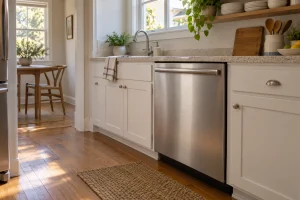
Dishwashers
Built-in Whirlpool dishwashers in San Francisco homes: the lineup in our library, where to find the model label, common drain and fill…

Specialized Whirlpool Appliance Repair in San Francisco
Mon–Sat: 8:00 AM – 7:00 PM
Water that will not drain, dishes that come out wet, a panel that blinks: we trace the cause under your counter and tell you what it needs.
In a small San Francisco kitchen, a dishwasher that stops working is more than an inconvenience. The sink fills up, the counter disappears under dishes, and a standing pool in the tub starts to smell. Whirlpool dishwashers share a general design: a pump moves water through spray arms, a drain pump and filter remove it, a fill valve admits it and a heating element helps dry the load. When something goes wrong, the symptom usually points to one of those systems.
The first suspects are the filter screen, a clog in the drain hose, a disposer connection that was never knocked out, a kink in the line, or a drain pump that no longer turns. Our post on a Whirlpool dishwasher not draining goes through the order of checks.
If plates come out dripping, the heating element, the vent, the rinse aid supply or the way the load was stacked may be responsible. Plastic stays wet more than glass, so the material matters. Whirlpool dishwasher dishes still wet explains how we narrow it down.
Many models signal faults by flashing the panel lights in a pattern or by showing a short code. Count the pattern, or write the code down exactly. See Whirlpool dishwasher lights blinking for what that can indicate.
A closed supply valve, a bent supply line, a clogged inlet screen or a fill valve that no longer opens leaves the wash with too little water. The dishwasher then runs, but the load does not come clean. Whirlpool dishwasher not filling has the details.
A worn door seal, too much detergent suds, a loose hose clamp or a cracked fitting can all leave water on the kitchen floor. In a flat with a unit below you, that is worth fixing quickly.
The door latch, the control board, the user interface and the motor circuit all affect whether the cycle begins. A latch that does not register can mimic a dead control.
Whirlpool dishwashers commonly use an F and E pair, such as F9E1, and a few use a word-style code, such as H2O. The meanings we hold are short and specific.
A code names an area to examine, not a part to buy. We confirm it by testing.
Do not take off the lower panel, test the wiring or reach into the pump area with the power on. For code F8E4, shut off the supply valve and leave the dishwasher alone until it has been looked at.
If water is spreading across the floor, switch the dishwasher off at the breaker, close the supply valve and soak up the water. Switch it off too if you smell something burning, notice a hot odor from the door area or see sparks. Do not run another cycle in a unit that is not draining; the water in the tub only gets worse.
Dishwasher pumps, valves and controls differ between lines. The label is usually on the inside edge of the door or the tub rim. A photo of it helps us arrive with parts that fit. Our library includes Whirlpool WDT970SAKZ repair, Whirlpool GU2800XTVQ repair from the Whirlpool Gold series, Whirlpool GU3000XTXQ repair, which is no longer sold new, and Whirlpool WDFS5118SS repair. For all of them, see Whirlpool dishwashers.
You send the symptom and the model label. The technician checks the drain path, the water supply, the latch and the pump, runs a short cycle if it is safe, and reads the fault. You then receive a written estimate. We repair only what you approve. If you rent, tell us before the visit so we can arrange access, and landlords can request a written note of findings.
A clogged filter, a drain hose problem, a disposer plug that was never removed or a failed drain pump are the usual causes. Clean the filter first, then book a diagnosis if water stays.
It means a long drain: the dishwasher is not draining. A technician checks the filter, the hose path and the pump.
No. Close the supply valve and cut power at the breaker until it has been inspected.
Possibly, but rinse aid, load pattern and plastics also matter. A diagnosis separates them before any part is replaced.
It helps, but you can book without it. The technician can locate it during the visit, and every repair waits for your approval.
Built-in Whirlpool dishwashers in San Francisco homes: the lineup in our library, where to find the model label, common drain and fill…
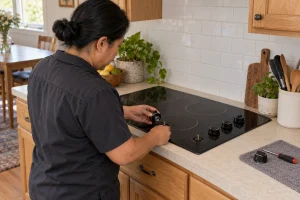
Radiant, gas and induction Whirlpool cooktops diagnosed in San Francisco and the Bay Area, with a written estimate before any repair begins.
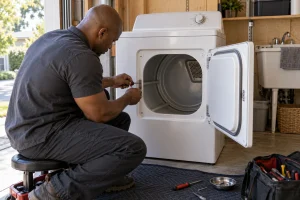
Gas, electric and ventless Whirlpool dryers diagnosed across San Francisco and the Bay Area, with a written estimate before any repair begins.
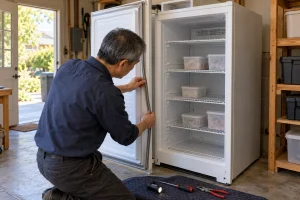
Whirlpool chest freezers that stopped freezing, frost over, or run all the time, diagnosed in garages, basements and utility closets around the…
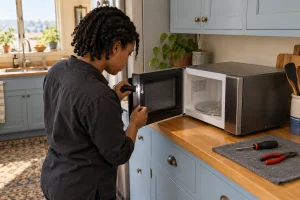
Diagnosis and repair for Whirlpool over-the-range microwaves that will not heat, show codes, stall the turntable or lose the fan and light.
Share a few details and we’ll confirm an appointment. Prefer to talk? Call us and we’ll help right away.