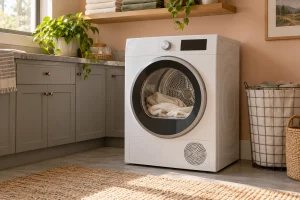
Dryers
Electric and gas Whirlpool dryers in San Francisco: models in our library, model label spots, vent and heating complaints, codes and safe…

Specialized Whirlpool Appliance Repair in San Francisco
Mon–Sat: 8:00 AM – 7:00 PM
Dryer not heating, stopping mid-cycle or showing a code? We trace the fault from the vent to the control before anything is replaced.
A Whirlpool dryer in a San Francisco home usually lives in a tight spot: a hallway closet, a basement garage nook, a stacked arrangement under a washer, or a shared laundry room down the stairs. That setting shapes almost every dryer problem we see, because a dryer is only as healthy as the path its air takes to the outside. Our Whirlpool dryer repair visits start with the symptom you describe, then follow the air, the power and the controls until the cause is clear, and nothing is repaired until you have approved a written estimate.
The heater is not always the culprit. A dryer that runs but leaves towels damp is often starved of airflow: a lint screen coated with a film, a long vent run with too many bends, a flexible duct crushed behind the machine, or an outside hood flap that is stuck shut with lint. Whirlpool’s own code meanings point the same way. The AF and F30 codes both say the lint screen or vent is clogged, and that the vent may be crushed, kinked or have too many turns. The F4E3 code carries the same wording for restricted air flow.
Once airflow is cleared, a technician looks at the heat side. On an electric dryer that means the heating element and the parts that switch it. On a gas dryer it means the igniter, the gas valve coils and the flame sensing path. The F4E1 code points at the heater or its relays, which tells us where to start.
A dryer that does nothing when you press start has several possible reasons, and most are simple to sort out in sequence. The door switch has to register a closed door. The start button and control have to be reading properly. Power has to arrive at the dryer. An electric dryer draws from a dedicated circuit with two legs, and if one is missing the drum may turn while the heater never comes on. The L2 and F31 codes describe this idea: a possible problem with the home power supply that keeps the heater from turning on, and the FE code is listed as a power source problem on compact heat pump dryers.
Dryers that quit mid-cycle are a different pattern. Overheating protection can shut the machine down when air cannot leave, and a worn drum support or belt can make the motor labor until it stops. If it thumps or squeals, tell us exactly when.
Many Whirlpool dryers show an F#E# style code, and a few show short letter codes. Write down what appears exactly as shown, including capital and lowercase letters. These pages cover the ones we can explain with confidence:
The full set is on our Whirlpool dryer error codes guide. A code narrows the search; it does not replace testing the part.
Where and how the dryer is installed often matters more than the dryer itself. We look at several things on arrival:
Before you book a visit, these are worth a few minutes, and all of them are done from the outside of the machine:
If you smell gas, leave the home right away, avoid switches and lights, and call the gas utility or 911 from outside. If you notice a burning smell, scorched lint or sparks, turn the dryer off at the breaker and stop using it.
Keep the dryer off if clothes come out hot enough to be uncomfortable to touch, if the laundry room smells of burnt lint, if the outside vent flap does not move at all, or if breaker trips repeat when you start a cycle.
Parts inside differ from model to model. The model label usually sits in the door opening, on the frame you see when the door is open, and sometimes along the edge of the door itself. A photo of that label, plus your code and a note of what you tried, lets us bring the right part list and a sensible plan. See how to find a Whirlpool model number if the label is hidden.
We confirm the symptom with you, then check the vent and airflow, the power supply, the door and start circuit, and the heating or condensing system. You then receive a written estimate that names the repair and the parts involved. If you decide against the repair, nothing is changed. If you approve it, the work proceeds, and we run the dryer again to confirm that it behaves properly.
Visits cover San Francisco and the Bay Area: flats, condominium buildings, in-law units and houses.
Our Whirlpool dryers guide describes the lineup. By model:
For symptoms, start with dryer not heating, dryer stops mid-cycle or dryer thumping noise.
Restricted airflow is the first suspect. A clogged lint screen, a crushed or overlong vent, or a stuck outside flap keeps moist air inside the drum. If those are clear, a technician checks the heating parts and the moisture sensing.
No. Leave the home, avoid switches, and call the gas utility or 911 from outside. Do not try to find the leak yourself.
Not always. On an electric dryer, a missing power leg, a tripped protection device or a control fault can produce the same result. That is why we diagnose before suggesting any part.
Yes. Without an outside duct, we check filters, the condensate path, sensors and the door circuit instead.
Electric and gas Whirlpool dryers in San Francisco: models in our library, model label spots, vent and heating complaints, codes and safe…
Radiant, gas and induction Whirlpool cooktops diagnosed in San Francisco and the Bay Area, with a written estimate before any repair begins.
Whirlpool dishwasher repair for San Francisco kitchens: standing water, wet dishes, blinking lights, leaks, filling trouble and display codes, diagnosed before repair.
Whirlpool chest freezers that stopped freezing, frost over, or run all the time, diagnosed in garages, basements and utility closets around the…
Diagnosis and repair for Whirlpool over-the-range microwaves that will not heat, show codes, stall the turntable or lose the fan and light.
Share a few details and we’ll confirm an appointment. Prefer to talk? Call us and we’ll help right away.