

Specialized Whirlpool Appliance Repair in San Francisco
Mon–Sat: 8:00 AM – 7:00 PM
The drum turns, the timer runs, and the clothes come out cool and damp. Sort out whether the problem is airflow, power or the heat source in a gas or electric dryer.
You open the door after a full cycle and the load is cool, or only warm, and still damp. The drum turned and the timer counted down, but the heat did not show up. People often call it a broken heater straight away. In truth, a dryer is a system of heat, airflow and sensing, and a failure in any of them looks the same from the laundry closet.
Know which type you have. Electric dryers use a heating element powered from a double breaker, and gas dryers use an igniter and a gas valve. The two fail differently. The model label and the connection behind the dryer show which one you have, and our Whirlpool dryer lineup guide explains where to look.
On an electric dryer, one half of a double breaker can trip or lose power, and the drum still turns because the motor needs only part of the supply. That produces a dryer that runs without heat. The library describes L2 as low or no line voltage, a problem with the home power supply that keeps the heater from turning on, and F4E4 gives the same description. Checking the breaker panel is an owner step. Switch the breaker off fully and back on, and run a short cycle.
On a gas dryer, a technician looks at the igniter, the gas valve coils and the flame sensing. You can check that the gas valve to the dryer is in the open position. Do not touch the gas fitting. If you smell gas, leave the home, avoid any switch, and call the gas utility or 911 from outside.
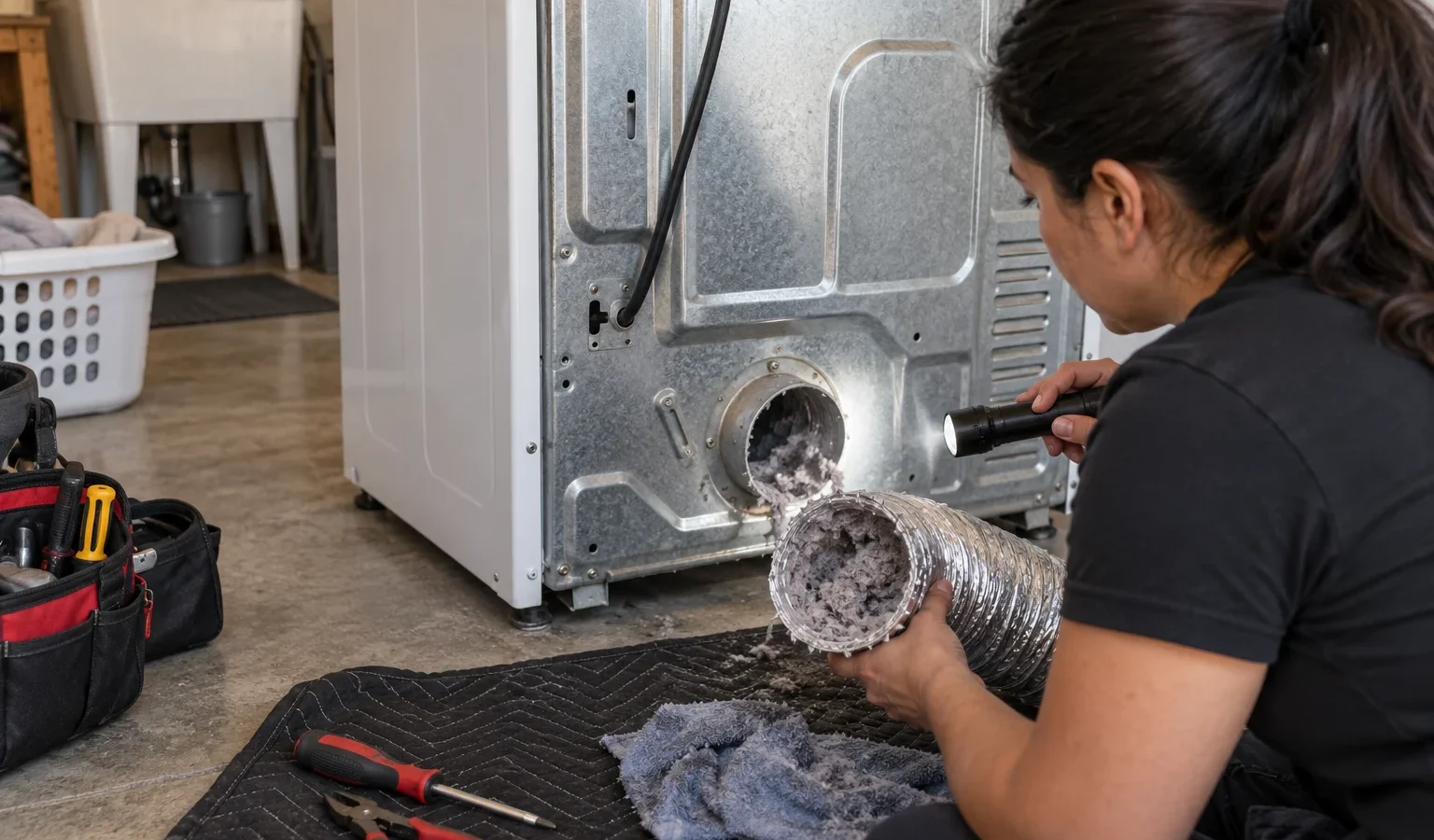
A dryer needs air to carry heat through the drum and out. When the lint screen, the duct or the outside hood flap is clogged, the dryer overheats and its safety devices cut the heat. The result is a dryer that turns but barely heats, or heats briefly and stops.
The library lists several airflow entries: AF, F30 and F4E3, all described as restricted airflow, where the lint screen or vent is clogged, crushed or kinked, or has too many turns. In San Francisco homes, long duct runs through a wall or a shared building duct make restriction very common, as does a dryer pushed against the wall so the duct kinks.
What you can do from outside: clean the lint screen, pull the dryer forward carefully to look for a crushed or kinked duct, and check that the outside vent hood flap opens when the dryer runs. Do not take apart ducts inside the wall.
Drying slowly is not the same as no heat. A dryer on a restricted vent heats, but the air cannot carry moisture out, and clothes stay damp. Test with a small load and see if the dryer ever feels warm at the door. If it does, the vent is the likelier issue. If the air is cold the whole cycle, the heat source or its power is the likelier issue.
Some dryers sense moisture and stop early. The library describes F3E2 as occurring when five consecutive loads are dried without registering moisture sensor data. An early stop leaves clothes damp too, though that is a sensing issue and not a heating one.
Control entries such as F1E3 and F6E1 describe possible issues with the control unit or associated wiring. Heater entries include F4E1, a possible problem with the heater or its relays, and for laundry towers F4E2, which lists the main heater as a potential cause. These name places to look, not parts to replace.
Ventless and compact heat pump dryers heat and dry in a different way. The library lists hE as a heating error where the temperature is too low or too high, and on vented models often a clogged lint screen or restricted vent. If you have a ventless unit, keep the lint filter and the condensation areas clean as your manual describes.
Do not remove panels, test the element or bypass a thermal safety. Do not run the dryer repeatedly on a clogged vent; heat has nowhere to go and a burning smell means switching off at the breaker. Never use a flame near a gas dryer.
A dryer in a closet, a stacked pair, or a shared vent in an older building has less room for error. Small kinks matter more. Our dryer repair service covers gas and electric, vented and ventless, and the diagnosis looks at the vent run as well as the machine. Related reading: the guide to dryer error codes explains the entries above.
Listed models include the Duet electric GEW9200L, the Duet gas GGW9200L and the gas WGD5000DW. The Cabrio electric WED8500DW is no longer sold new.
Book when the vent checks and breaker steps do not restore heat, when a heater or voltage code returns, or when you smell gas or burning. The visit starts with a diagnosis, a written estimate follows, and nothing is repaired without your approval.
Heat can be missing because of power to the heater, a heat source problem, or a restricted vent that triggers a safety cutoff. Those three look alike from outside.
Yes. A dryer with half of a double breaker lost can still turn the drum. Reset the breaker fully and try a short cycle.
If the dryer gets warm briefly and clothes stay damp, or the outside hood flap barely moves, airflow is the likelier cause.
Yes, if you pull it forward gently and check for a kinked duct. For a gas dryer, do not move it far enough to stress the gas line.
Leave the home, avoid switches, and call the gas utility or 911 from outside.
Share a few details and we’ll confirm an appointment. Prefer to talk? Call us and we’ll help right away.