

Specialized Whirlpool Appliance Repair in San Francisco
Mon–Sat: 8:00 AM – 7:00 PM
The dryer starts, runs a while and quits with the clothes still damp. Learn what makes a dryer shut itself off partway through and which checks are safe at home.
The dryer starts normally, tumbles for a while, and goes silent before the cycle ends. You open the door to find damp clothes and a drum that may be hot or barely warm. Restarting it sometimes works for another stretch, then the same thing happens. Because a stopping dryer is shutting itself down, the useful question is why.
Compare this with a dryer that never heats, covered in our guide to a dryer that is not heating. Here the dryer begins fine and quits later. That timing is a clue, because the causes are tied to what changes over the course of a cycle: temperature builds, airflow slows, a door shifts and a load gets heavier.
The most common reason is a restricted vent. As the cycle runs, hot air cannot escape, the temperature inside rises, and a safety device cuts the heat or stops the dryer. After it cools, it runs again for a while. If this matches your dryer, the pattern is distinctive: it runs, quits, and restarts after a rest.
The library lists AF, F30 and F4E3 as restricted airflow, with a clogged lint screen or vent, or a vent that is crushed, kinked or has too many turns. In San Francisco, long vent runs through walls, shared building ducts and dryers set against the wall make this common.
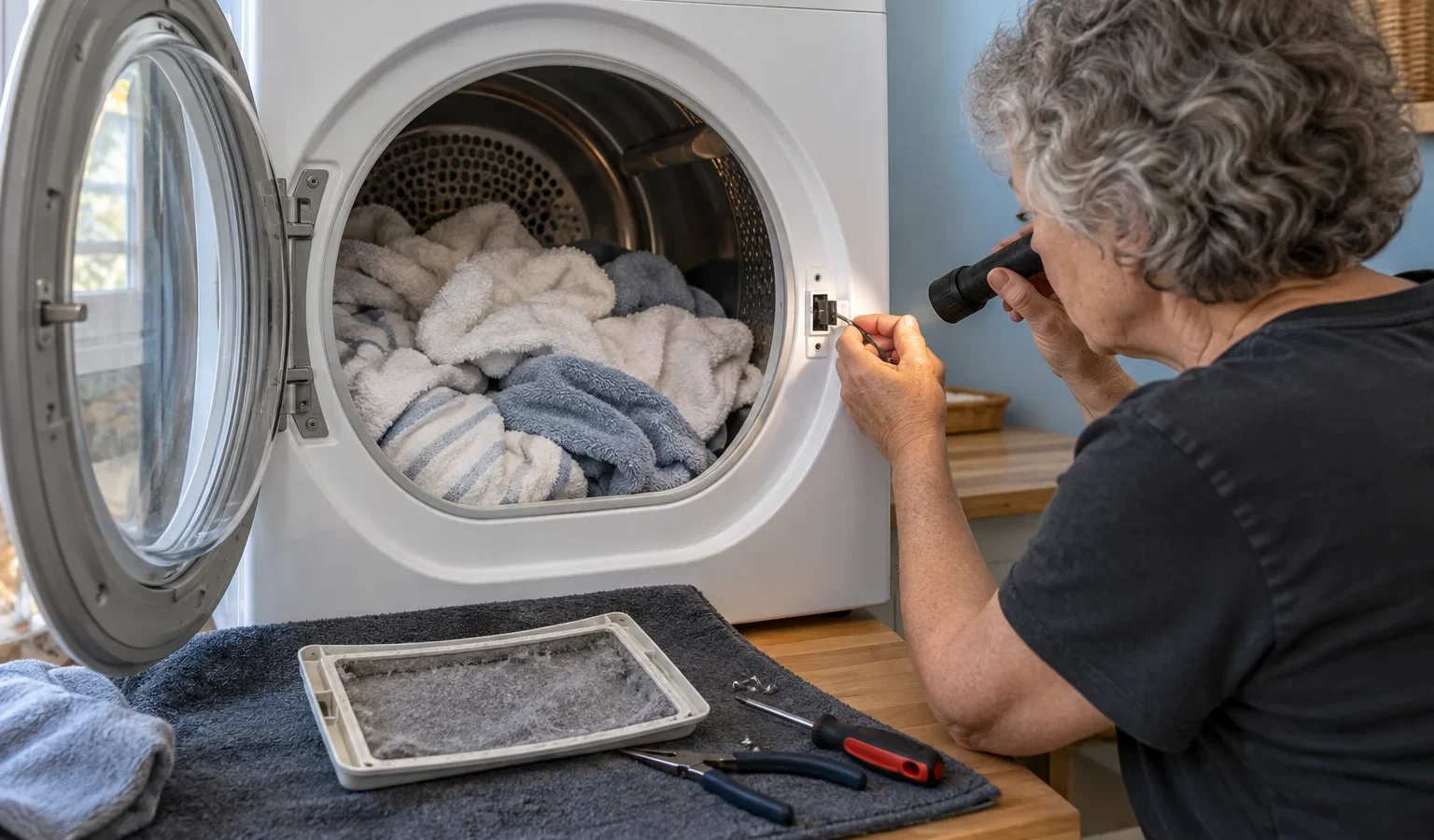
Owner checks: clean the lint screen, pull the dryer forward gently to look for a kink or crushed duct, and check that the outside hood flap opens when the dryer runs. If the flap barely moves, the restriction is probably downstream.
A dryer will not run with the door open. If the door switch or latch is worn, a small shift or vibration during the tumble can break contact, and the dryer stops. You may notice it stops when you bump the cabinet, or that the door seems to need a firm push.
Look at the door seal and catch for lint buildup or damage, and make sure no item is pinching the edge. The library lists F5E1 and F5E2 for laundry towers, both describing the door switch as the potential cause, and compact dryers use do when the dryer is run with the door ajar, and dC for a door circuit failure.
A dryer that stops mid-cycle can have a power problem that only appears under load. The library entry PF means the drying cycle was interrupted by a power failure, and L2 describes low or no line voltage keeping the heater from turning on. If the lights flicker, other appliances on the same circuit trip, or the breaker is warm or loose, tell the property manager or an electrician. Do not open the outlet or the breaker panel.
A drum jammed with wet bedding can overload the motor, and a dryer may stop partway through. The library notes F0E3 on laundry towers as over load detection. Take out a portion of the load, or dry large items in smaller batches, and see whether the problem disappears.
Moisture sensing can end a cycle too early. The library lists F3E2 for five consecutive loads dried without registering moisture sensor data. Control and wiring entries such as F1E3 and F6E1 describe possible control unit or board issues. A cycle that ends early with damp clothes and no code is often a sensing or control matter, which a technician sorts out.
If the dryer stops with a thump, a squeal or a burning smell, the cause may be mechanical, such as a belt, a roller or the motor. Our article on a dryer thumping noise covers those sounds. Burning smells or sparks mean switching off at the breaker and leaving the dryer off.
Do not keep restarting a hot dryer over and over; it adds heat to a system already trying to cool off. Do not defeat a door switch or a thermal safety. Do not remove the back panel. In a gas dryer, do not touch gas fittings; a gas smell means leaving the home and calling the gas utility or 911 from outside.
An electric dryer that quits can also have lost half its breaker supply. A gas dryer that quits may have an igniter or flame sensing issue. The timing tells you something, and the technician uses it. Our dryer repair service covers both, and the Whirlpool dryers guide points to the label location.
Listed examples include the gas WGD5000DW and the Duet electric GEW9200L.
Book if the dryer keeps stopping after vent and load checks, if a code returns, or if you smell burning. The visit starts with diagnosis, a written estimate follows, and nothing is repaired without your approval.
A hot dryer on a restricted vent shuts down to protect itself, cools off and runs again. Check the lint screen, the duct and the outside flap.
Yes. A worn door switch or latch can lose contact during tumbling and stop the cycle. A firm push on the door sometimes shows the pattern.
It can strain the motor and shorten the run. Dry bulky items in smaller batches and see whether it changes.
No. Vents, loads and power are common causes. A diagnosis finds which one before any part is replaced.
When it stops, whether it is hot or cool, any code, and what the vent and lint screen looked like.
Share a few details and we’ll confirm an appointment. Prefer to talk? Call us and we’ll help right away.