

Specialized Whirlpool Appliance Repair in San Francisco
Mon–Sat: 8:00 AM – 7:00 PM
The label with your model number is almost always in a predictable spot for each appliance type. Here is where to look, how to read it and what to write down.
When you call about a repair, the first thing we ask is the model number. It tells us the exact appliance, the fuel or control style, and which published code list applies. It is also the quickest way to avoid a wasted trip, because two machines that look identical from the front can be built differently inside.
The label is a small plate or sticker, and it is usually placed where a technician can see it without taking the appliance apart. That is also where you can read it without moving anything heavy. Below are the usual locations, appliance by appliance. Where a spot varies, check the next one.
On a refrigerator, the label is usually on the inside wall near the top, along the door frame or on the ceiling of the fresh-food compartment. On some units it is behind a crisper drawer or on the lower inside wall. A chest freezer often has it on the inner wall near the top rim or on the back of the cabinet. Open the door fully and look at the frame edges before you start emptying shelves. See Whirlpool refrigerator repair and Whirlpool freezer repair for what we diagnose.
A dishwasher label is usually on the edge of the tub or the inner door frame, visible when the door is open, or along the side of the door panel. Pull the lower rack out for light and look along the rim. For service details, read Whirlpool dishwasher repair.
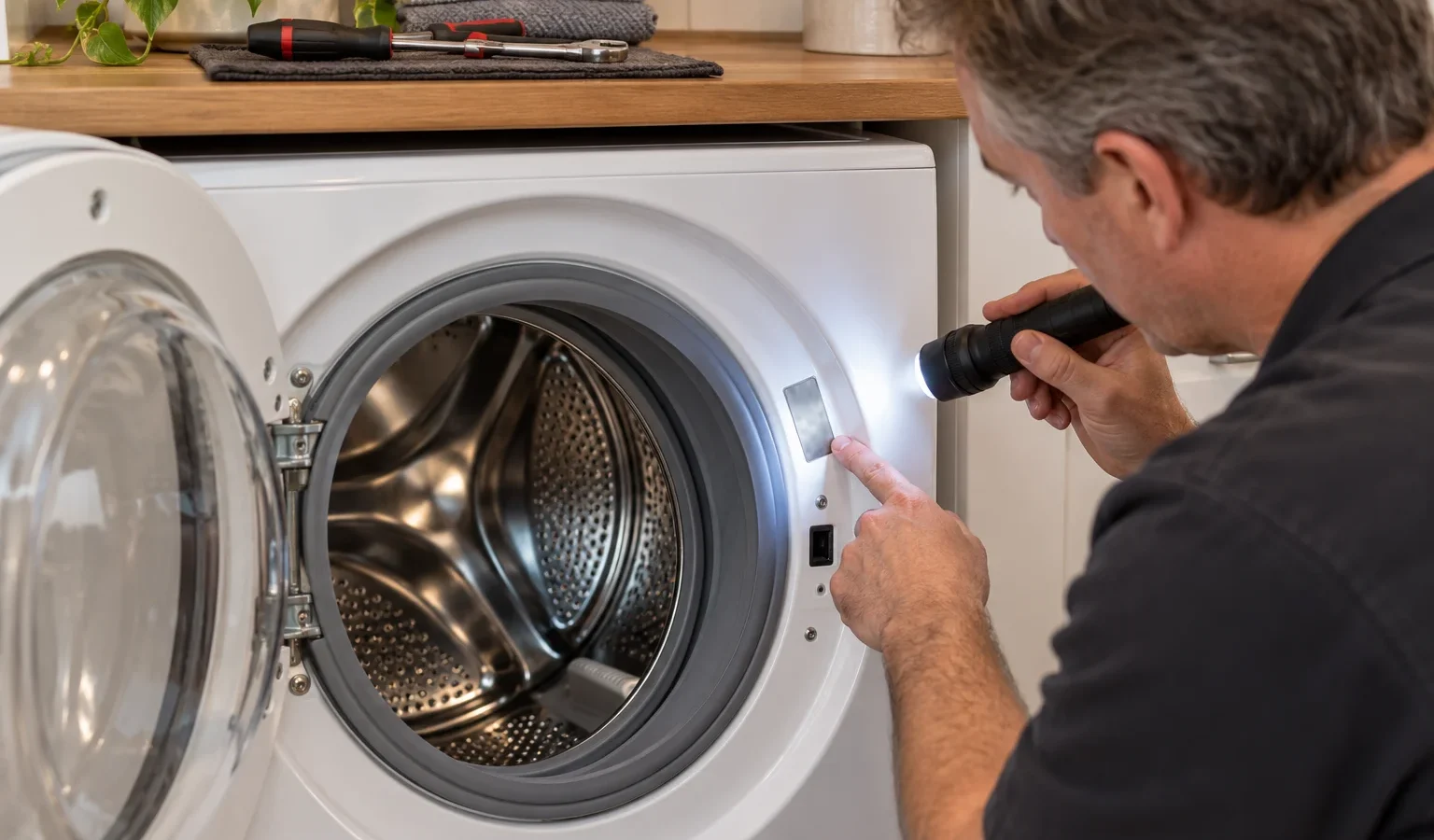
A top-load washer usually has its label inside the lid rim or under the lid, while a front-load washer usually has it around the door opening or on the inside edge of the door. A dryer’s label is usually inside the door opening, on the frame or along the door edge. In stacked or closet laundry, you may need to open each door fully and use a phone flashlight. If the machines are stacked, read the label for the one that is giving trouble, not its neighbor. The overview pages are Whirlpool washer repair and Whirlpool dryer repair.
A range label is usually on the frame behind the oven door, or on the edge of the storage drawer when you pull it out. Cooktops often carry it on a plate beneath the edge of the unit or inside the cabinet below. A wall oven has it on the oven frame, visible when the door is open, and double ovens may have a label on each cavity or one for the whole unit. See Whirlpool range repair, Whirlpool cooktop repair and Whirlpool wall oven repair.
An over-the-range microwave usually has its label inside the cavity on the door frame or side wall. A range hood often has it behind the filters, on an inner wall or panel. Take out the grease filters carefully and shine a light inside. Do not unscrew the housing. For the service pages see Whirlpool microwave repair and Whirlpool range hood repair.
A model label is a line of letters and digits, often followed by a serial number on a different line. Copy the whole model line exactly, including letters that look like numbers. A capital O and a zero, or a letter I and a one, are easy to mix up. Take a clear photo as well, and read it back before you send it. We do not need you to decode it; just copy it.
Please do not guess at part of it or fill in digits from memory. If one character is unreadable, say so and send the photo. We can usually confirm the rest.
If you manage several units, keep a simple list with the unit, the appliance type and the model line for each one. One building often holds several generations of the same appliance, and a tenant describing a stove as the old white one does not tell us which version is in the kitchen. A photo taken at move-in, filed with the lease paperwork, saves a phone call when something breaks months later.
Do not pull a built-in appliance out of its cutout or move a gas range to look at the back. Gas connections and anti-tip brackets are not owner work.
The model number lets us look up the published meanings of any code on your display, confirm whether the unit is an electric or gas version and see whether it has a single or double cavity. In our library, for example, WRFF3536SV is listed as a refrigerator and WTW5057LW as a washer. See the full list on the models page. If a code is showing, check the error codes index too.
With the label in hand, you can describe the problem accurately and book a visit. We diagnose before repairing, give a written estimate and do nothing without your approval.
Usually inside the lid rim on a top-load machine, or around the door opening on a front-load machine. Open the door or lid fully and look along the edges.
No. They are separate lines on the label. We ask for the model number first, and the serial number only if we need it.
Photograph whatever is readable and tell us the appliance type, the fuel and any visible markings. We can often identify the machine from those details.
No. Check the usual places first. Do not move gas appliances or built-in units to look for a label.
We do not read hidden meanings into the characters. The number is simply the exact identifier we use to look up your appliance.
Share a few details and we’ll confirm an appointment. Prefer to talk? Call us and we’ll help right away.