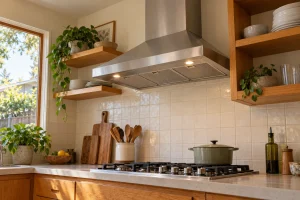
Range Hoods
Under-cabinet Whirlpool range hoods in San Francisco kitchens: where the label sits, light and fan complaints, and safe checks to try before…

Specialized Whirlpool Appliance Repair in San Francisco
Mon–Sat: 8:00 AM – 7:00 PM
A technician checks filters, duct, switch and motor in order before anything is replaced.
A range hood is one of the few appliances in a kitchen that works against heat, grease and moisture at the same time. In San Francisco, where many kitchens are small and the cooktop sits a few feet from the living space, a weak or noisy hood is noticed immediately. This service covers Whirlpool range hoods in homes, flats, condos and rentals around the Bay Area, whether the hood sends air through a wall or roof, or just filters it back into the room.
The commonest complaint is that cooking smell and steam hang around even with the fan on high. The cause may be the hood itself, but it may also be the duct, the outside cap or the filters. A technician checks them in that order from the cooktop outward. Heavy frying in a compact kitchen loads grease onto the filter fast, and a saturated filter acts like a closed door.
A hood that hums, rattles or squeals has loose or dirty parts. A blower wheel with grease on its blades goes out of balance. A motor with worn bearings makes a rhythmic scrape. A loose duct collar or a filter that is not latched correctly can sound like a motor problem. Distinguishing them takes a look, not a guess.
Lamps burn out, but the fault may also be a socket, a switch or wiring in the light circuit. Our Whirlpool range hood light not working article covers the symptom step by step.
If no speed responds, the problem might be the switch, a capacitor-style start part, a connection or the motor. If one speed is lost but the others work, the switch or the speed wiring comes into question. Unlike a microwave, a hood shows few codes, so the technician relies on testing instead of display messages.
We start with what you describe and where the hood vents. The technician looks at the filters, the grille, the lamp area and the visible duct, then tests the switch and the motor in a controlled order. For a hood tucked under a cabinet, access to the blower is often tight, so the work is planned before anything is taken apart. A written estimate follows the diagnosis, and nothing is repaired until you approve it.
Do not remove the blower housing, test the motor leads or bridge the switch. If you smell burning, turn the hood off at the breaker.
Switch it off if there is a burning smell, visible smoke from the motor area, sparking, or a loud scrape that is getting worse. A hood with a dripping grease tray or loose canopy should also stay off over the cooktop until it has been checked.
Hoods share a basic shape, but the filter, blower and light parts differ by model. Our library lists UXT4230ADS as an under-cabinet hood, thirty inches wide, with a 225 CFM series label. Yours may differ, and the label settles it. It is usually found on the inside wall of the hood, behind the filters.
You request a visit, describe the symptom and tell us how the hood vents. The technician diagnoses first, writes up the estimate, and waits for your approval before work. In buildings with shared entries or street parking, tell us when you book so that access is smooth.
Browse the lineup on Whirlpool range hoods. If your cooking area uses a combined unit, see Whirlpool microwave repair, and for the cooking surface itself, Whirlpool cooktop repair.
Not necessarily. A grease-loaded filter, a blocked damper at the outside cap or a duct that has been crushed behind the cabinet all produce the same weak pull. Clean the filters first, listen for the outdoor flap, and check that nothing blocks the grille. If airflow stays poor, a technician checks the blower wheel, the motor and the duct run in order.
A dead light can be a spent lamp, a loose socket, a switch fault or a problem in the control. Check that the lamp type matches the hood and that it is seated, with the power off. If a new lamp does not light, our article on range hood light not working helps sort the causes.
Often a rattle is a filter that sits crooked, a loose duct connection or a blower wheel that has picked up grease and gone slightly out of balance. Loose pieces you can see from outside are owner checks. A growing metallic scrape or a smell of heat is a reason to switch it off at the wall and book a visit.
Yes. A recirculating hood has a charcoal filter, a blower and a switch like any other, and a technician can diagnose the blower, motor, switch and light the same way. The filter type changes how much smell it removes, not how repairable the hood is.
Look on the inside wall of the hood, behind or beside the filters, for a label with the model number. Our library lists UXT4230ADS as an under-cabinet hood in thirty inches. Photograph the label and mention how the hood vents when you book.
Under-cabinet Whirlpool range hoods in San Francisco kitchens: where the label sits, light and fan complaints, and safe checks to try before…
Radiant, gas and induction Whirlpool cooktops diagnosed in San Francisco and the Bay Area, with a written estimate before any repair begins.
Whirlpool dishwasher repair for San Francisco kitchens: standing water, wet dishes, blinking lights, leaks, filling trouble and display codes, diagnosed before repair.
Gas, electric and ventless Whirlpool dryers diagnosed across San Francisco and the Bay Area, with a written estimate before any repair begins.
Whirlpool chest freezers that stopped freezing, frost over, or run all the time, diagnosed in garages, basements and utility closets around the…
Share a few details and we’ll confirm an appointment. Prefer to talk? Call us and we’ll help right away.