Cooktops
Radiant, gas and induction Whirlpool cooktops: where to find the label, what the codes mean and how to check a dead burner…

Specialized Whirlpool Appliance Repair in San Francisco
Mon–Sat: 8:00 AM – 7:00 PM
One zone cold, a burner that will not light or a code on the touch panel? We identify the cooktop type first, then find the fault.
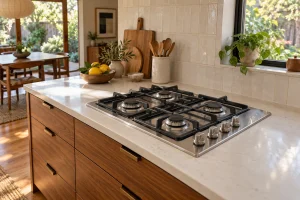
Cooktops are the one Whirlpool appliance where three different technologies share a single name. A radiant glass-top heats a ribbon element under the ceramic, a gas cooktop lights a flame at each burner, and an induction cooktop uses coils that heat the pan itself. A technician who treats them alike will waste your time, so every visit starts by identifying which kind you own. Then we diagnose, give you a written estimate, and repair only what you approve.
When one zone stays cold while the others work, the likely suspects are the element under the glass, its connection, the switch that controls it, or the hot-surface sensing. The library lists F12 as a possible problem with a hotplate (a cooking surface, burner or element) or its wiring. Codes for a single zone, such as the FC LF, FC LR, FC RF and FC RR entries, name a left front, left rear, right front or right rear hotplate, which narrows the search before we lift anything.
Heat protection is another common story. The C81 and C83 codes mean the cooktop has overheated, and C82 says the surface cooking area overheated and the automatic shutoff was activated. F2 describes a surface area that is too hot and clears once it has cooled. F8 says a surface area has been in operation too long. These are protective responses, not always faults, so we confirm what was on the glass and for how long before we blame a part.
Our glass cooktop element not heating guide covers that symptom in detail.
An induction surface stays cool and the cookware does the heating, so complaints sound different: a zone that will not start, a pan that is not recognized, or a panel that shuts off. The E2 code says the cooktop is too hot and the control panel switches off because of excessively high temperatures. Cooling airflow matters here, so a cooktop installed over a blocked cabinet or a drawer packed tight below it deserves a look. The F36 and F37 codes mention a temperature sensor on an induction coil.
A gas cooktop needs a spark, clean ports and a steady supply. Constant clicking, a flame that lights only on one side, or a burner that will not light often traces back to spilled food in the cap or head. We check the cap seating, the electrode and the spark module. Gas fittings below the unit are handled only by a technician, and you should never loosen them yourself.
If a burner runs but the flame looks uneven, or one burner is far weaker than its neighbors, mention that when you book. A partly blocked port, a misaligned cap and a supply problem look alike from the kitchen but need different fixes.
Many cooktops use touch controls, and moisture or a spill across the keys can confuse them. F1E0 indicates that one or more keys are permanently pressed, which is often just a wet or dirty panel. Power supply codes are different: F25 notes a problem with the power supply to the cooktop. We look at the circuit and the connection before we consider the control board.
Most cooktops sit in a cutout in the counter, and what is beneath them decides how we work:
Small San Francisco kitchens, where a cooktop sits beside a refrigerator and a narrow counter, add another wrinkle: we tell you early if the counter or the neighboring cabinets will limit access.
If you smell gas, leave the home, avoid switches, and call the gas utility or 911 from outside. If you see cracks in the glass, sparks or smell burning, switch the cooktop off at the breaker and stop using it.
The number tells us whether you have a radiant, induction or gas surface, and which controls and parts apply. On a cooktop the label is usually found on the underside of the unit, on a tag near the supply, or in the original paperwork. If you cannot reach it, take a photo of the whole surface and the touch panel and send it when you book. See how to find a Whirlpool model number.
We confirm the symptom, identify the cooktop type, check the supply, and then test the zone, control or burner at fault. You receive a written estimate afterward. Nothing is repaired without your approval. We visit homes across San Francisco and the Bay Area, from flats to house kitchens.
Browse the Whirlpool cooktops guide for the lineup. Library models include WCE97US6KS, an electric triple radiant cooktop, WCG97US6HS, a gas cooktop with a griddle, and WCI55US0JS, an induction cooktop. If the oven below is the issue, see Whirlpool range repair.
Overheat protection can shut a zone off. The C82 and F2 codes describe overheated surface areas, and F8 describes a surface that has run too long.
Not necessarily. Induction needs suitable cookware that sits flat on the zone. If a suitable pan still does nothing, a technician checks the coil, the sensor and the control.
Yes. Liquid across touch keys can read as a pressed key, and F1E0 describes keys that are permanently pressed. Dry the surface and try again.
A radiant glass surface holds heat for a while, and some models show a hot-surface indicator until it cools. If the indicator never goes out, tell us what it shows.
No. Turn it off at the breaker and stop using it until a technician has looked at it.
Radiant, gas and induction Whirlpool cooktops: where to find the label, what the codes mean and how to check a dead burner…
Whirlpool dishwasher repair for San Francisco kitchens: standing water, wet dishes, blinking lights, leaks, filling trouble and display codes, diagnosed before repair.
Gas, electric and ventless Whirlpool dryers diagnosed across San Francisco and the Bay Area, with a written estimate before any repair begins.
Whirlpool chest freezers that stopped freezing, frost over, or run all the time, diagnosed in garages, basements and utility closets around the…
Diagnosis and repair for Whirlpool over-the-range microwaves that will not heat, show codes, stall the turntable or lose the fan and light.
Share a few details and we’ll confirm an appointment. Prefer to talk? Call us and we’ll help right away.