Ranges
Electric and gas Whirlpool ranges in San Francisco kitchens: the lineup in our library, where to find the model label, oven and…

Specialized Whirlpool Appliance Repair in San Francisco
Mon–Sat: 8:00 AM – 7:00 PM
Oven cold, burner clicking or a code on the display? We trace the cause before replacing any part.
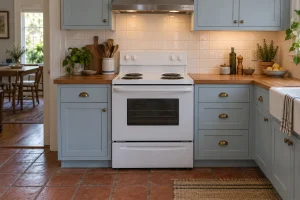
In a San Francisco kitchen, a Whirlpool range often sits in a narrow galley, wedged between cabinets, with a wall of tile behind it and very little room to pull it forward. That is the first thing we plan around. A range combines a cooking surface, an oven, a control and, on gas models, a supply line, so a complaint such as “it will not heat” can start in several places. We find the real cause before any part is replaced, and we give you a written estimate to approve first.
On an electric range the oven uses a bake element below and a broil element above, each switched by the control. If one never glows, the element itself may have failed, or the wiring, the relay or the control that feeds it. The library lists FEE6 as a possible problem with the main cavity bake element or its wiring, and FEE7 for the broil element. On a gas range the oven relies on an igniter that must draw enough current to open the gas valve; a weak igniter glows but never lets the gas flow. Uneven heat can also be a temperature sensor drifting, which is why codes such as F01 and F02 name the oven temperature sensor, the control or the wiring as the area to check.
Our guide to an oven that is not heating walks through the symptom in more depth.
A gas burner needs a spark, a clean port and a steady supply of gas. Spilled food in the burner cap is the usual reason for constant clicking, because the spark module keeps trying to light something it cannot reach. If one burner works and the others do not, we look at that burner’s cap, base and spark electrode. If none light, the focus moves to the module and the power feeding it. Read more in gas burner clicking.
Electric surface elements fail differently. A coil that stays cold may have a bad element, a worn receptacle or a failed switch. A smooth-top surface that shuts itself down may be showing a code like C81, C82 or C83, which the library describes as an overheated surface cooking area where the automatic shutoff was activated.
A door that will not unlock after a clean, or an oven that refuses to start a clean, usually points at the latch assembly, its switch or the wiring. Codes such as F05 and F9-1 mention the door latch or the door lock switch. F5E5 is more specific: the oven has not reached self-clean temperature after 30 minutes. Do not force a locked door. Forcing it can bend the latch and turn a small problem into a bigger one.
A range has a cooling fan that protects the controls. When it runs too slowly or too fast, the control reports it, and F8E0 mentions an airflow restriction, the oven cooling fan or the wiring. A meat probe code such as F3E4 may only mean the probe is not seated in its receptacle. Display and keypad faults can look dramatic, but a frozen screen is sometimes cured by a single controlled power reset. The complete set lives in our Whirlpool range error codes guide.
If you smell gas, leave the home, avoid light switches, and call the gas utility or 911 from outside. If you smell burning or see sparks, shut the range off at the breaker and stop using it. Do not open panels or reach into the back of the range.
Range controls differ widely, even between neighbors in a lineup. The model label is usually on the frame around the oven door, inside the oven opening, or on a plate under the storage drawer. A photo of that label, plus the code, lets us plan parts and tools before we arrive. See how to find a Whirlpool model number.
We start with the symptom, then check the supply, the controls and the cooking parts one at a time. After the diagnosis you receive a written estimate describing the repair. You decide whether to go ahead, and nothing is repaired without your approval. We serve San Francisco and the Bay Area, including rentals where one landlord manages several units.
The Whirlpool ranges guide covers the lineup. Models in the library include WFE515S0JS and WFE525S0JZ, both freestanding electric, WFG525S0JZ, a freestanding gas model, and WGE745C0FS, an electric double oven range. If you cook on a separate surface, see Whirlpool cooktop repair.
The spark module keeps firing if the electrode is wet or dirty. Cleaning the burner cap and head often helps; if the clicking stays, a technician checks the module and wiring.
A weak igniter usually stops the oven from lighting rather than creating danger, but if you ever smell gas, leave the home and call the gas utility from outside.
Write the code down first. One controlled power reset at the breaker is fine, but if the code returns, the control or a sensor needs testing.
Yes. A range that has been pulled out for service should be secured again afterward, and we check that the bracket is engaged.
Yes. We plan for limited space, and we tell you in advance if cabinets or tile will limit how far the range can be moved.
Electric and gas Whirlpool ranges in San Francisco kitchens: the lineup in our library, where to find the model label, oven and…
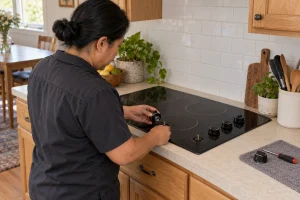
Radiant, gas and induction Whirlpool cooktops diagnosed in San Francisco and the Bay Area, with a written estimate before any repair begins.
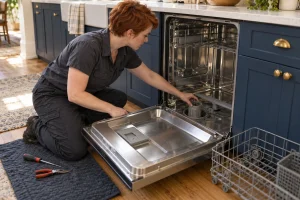
Whirlpool dishwasher repair for San Francisco kitchens: standing water, wet dishes, blinking lights, leaks, filling trouble and display codes, diagnosed before repair.
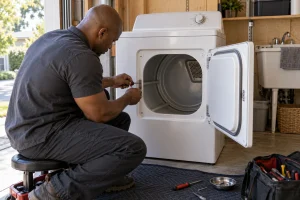
Gas, electric and ventless Whirlpool dryers diagnosed across San Francisco and the Bay Area, with a written estimate before any repair begins.
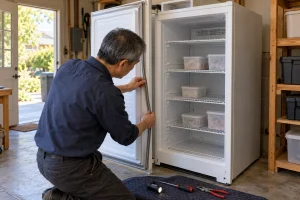
Whirlpool chest freezers that stopped freezing, frost over, or run all the time, diagnosed in garages, basements and utility closets around the…
Share a few details and we’ll confirm an appointment. Prefer to talk? Call us and we’ll help right away.