

Specialized Whirlpool Appliance Repair in San Francisco
Mon–Sat: 8:00 AM – 7:00 PM
An oven that stays cold, heats slowly or only works on one rack position has a short list of causes. Here is how to sort them out in a San Francisco kitchen.
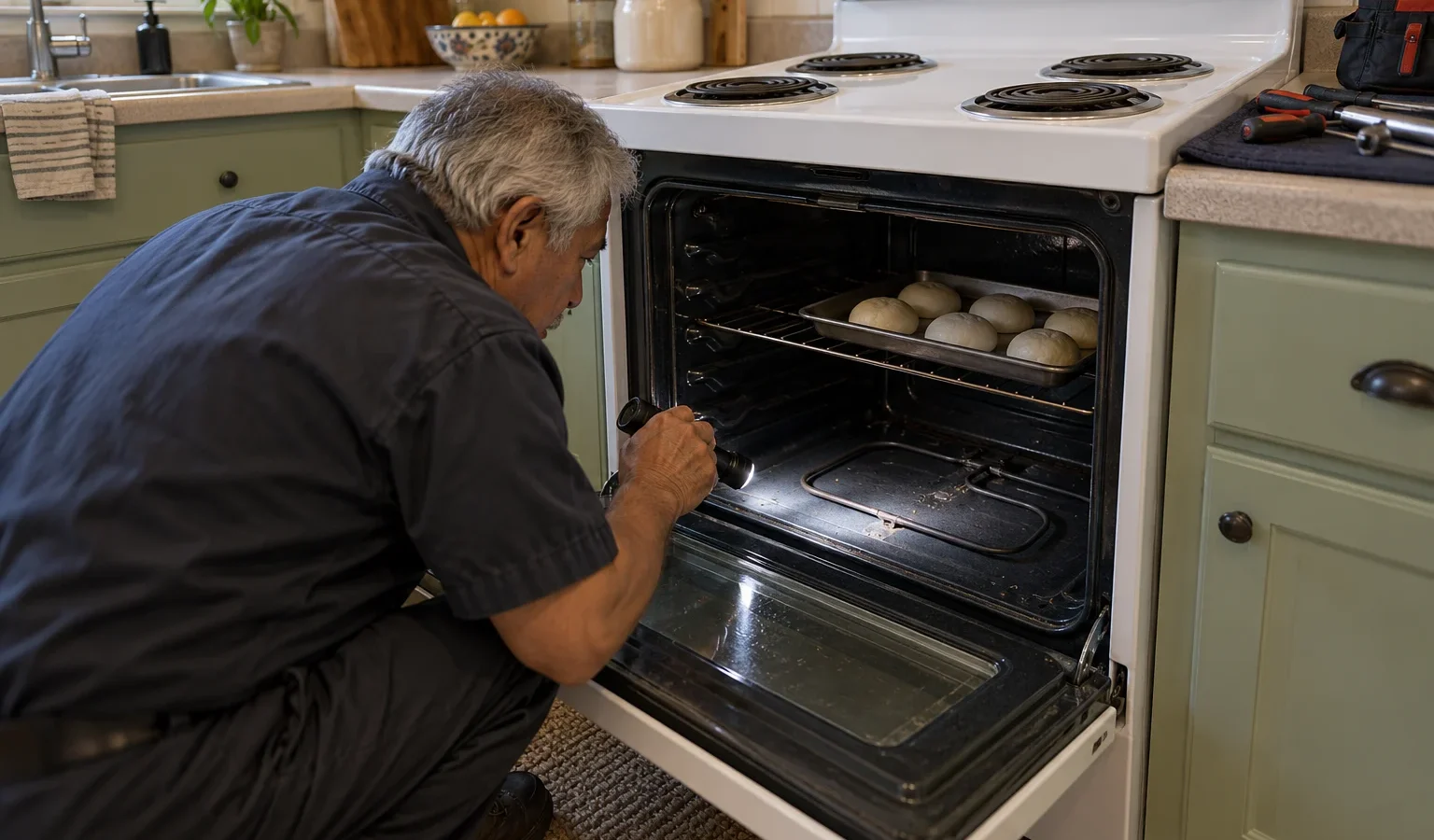
A Whirlpool oven that will not heat is rarely a mystery once you separate three situations: the range has no power at all, the controls are alive but the oven never starts to warm, or the oven warms but cannot hold the setting. Each points somewhere different, and the way the oven behaves in the first few minutes tells you which one you have.
In San Francisco the story often starts with a rental or condo kitchen where the range has been in place for years, shared with a landlord who standardizes on one brand. Before assuming a failed part, look at what the oven is actually doing.
Turn the oven to bake and watch the display. If the display is dark, you are not dealing with an oven fault yet, you are dealing with power. If the display lights, the clock runs and the oven announces a preheat but the cavity stays cold, the problem is in the heating path. If a code appears, write it down exactly as shown before you touch anything else.
Start at the outlet end. An electric range runs on a dedicated high-capacity circuit, and in older San Francisco buildings it is common to find a breaker that has tripped partway, which leaves the cooktop and clock alive while the oven side stays dead. Switch the range breaker fully off, then fully on. Do that once. If it trips again, stop.
Next, confirm the oven is set the way you think it is. Check that the clock is not in a lockout or sabbath-style hold, that the control is not in a timed-bake mode waiting for a start time, and that the door is fully closed. A door that sits slightly ajar on a tight galley kitchen cabinet run, or one caught on a pulled-out rack, can keep an oven from starting.
On a gas range, confirm the gas valve behind or beside the range is open and that other gas appliances in the unit work. A gas oven that clicks but never lights, or that lights and drops out, is a different symptom from an electric oven that does not warm. Do not try to look inside the burner compartment or touch any gas fitting.
Finally, try one controlled power reset: switch the range off at the breaker, leave it off briefly, then restore it and set a simple bake again. If nothing changes, further resets will not help.
The bake element is the part that glows in the bottom of the cavity. Over time it can crack or open up, which stops it heating while everything else on the range works normally. A technician will look at the element and the wiring leading to it, and will check that the control is actually sending power when it should.
Gas ovens rely on an igniter that must glow strongly enough to let the gas valve open. A weak igniter is a classic cause: the oven seems to try, the glow looks fine to the eye, and yet the flame never appears. A technician tests the igniter and the valve as a pair, because replacing one without confirming the other often leaves the oven still cold.
Both fuels use an oven temperature sensor to tell the control how hot the cavity is. If it drifts, the oven can heat too little, shut off early or behave inconsistently from one bake to the next. Whirlpool’s published code list ties several F-series codes to the oven temperature sensor or the control, which is why reading and recording a code is useful. Our guide to Whirlpool range error codes explains how the codes are grouped, and the code page for F01 gives the published meaning for that one.
If you smell gas, leave the unit, do not touch switches, and call the gas utility or 911 from outside. If you see sparks, smell burning wiring or see scorched marks near the element terminals, switch the range off at the breaker and leave it off. An oven that heats on its own with the controls set to off is also a reason to cut the power and call us.
Bay Area kitchens hold a mix of electric and gas freestanding ranges. In our model library, WFE525S0JZ is listed as a freestanding electric range and WFG525S0JZ as a freestanding gas range, both still sold new. WGE745C0FS is listed as an electric double oven range. The complaint is the same on all of them, but the first diagnostic step differs between gas and electric, so tell us which fuel you have.
When you book, have the model label ready; on a range it is usually on the frame behind the oven door or the edge of a storage drawer. Our guide to finding a Whirlpool model number shows the usual spots. We diagnose first, give you a written estimate, and repair nothing until you approve it. The full service description is on Whirlpool range repair, and the lineup overview is on Whirlpool ranges.
The control is receiving power, so the fault is further along the heating path. On an electric range that often points to the bake element or its wiring. On a gas range it points to the igniter or gas valve. A technician tests those parts before replacing any of them.
Yes. On many electric ranges the oven and the surface elements are fed separately, so one side can work while the other is dead. A tripped or weak breaker can also affect just one side. That is why one breaker reset is a fair first step.
Slow heating is a sign something is wearing out, but it is not by itself dangerous on an electric oven. Stop if you notice a burning smell, sparks or any gas odor. Do not use a gas oven that lights unreliably.
It helps a great deal because it tells us the fuel and the control style before we arrive. Read it from the label and write down any code on the display as well.
No. We diagnose, give a written estimate, and only repair once you approve it.
Share a few details and we’ll confirm an appointment. Prefer to talk? Call us and we’ll help right away.