

Specialized Whirlpool Appliance Repair in San Francisco
Mon–Sat: 8:00 AM – 7:00 PM
A glass plate that sits still, wobbles or grinds is usually a seating problem before it is a motor problem. Walk through the easy checks first.
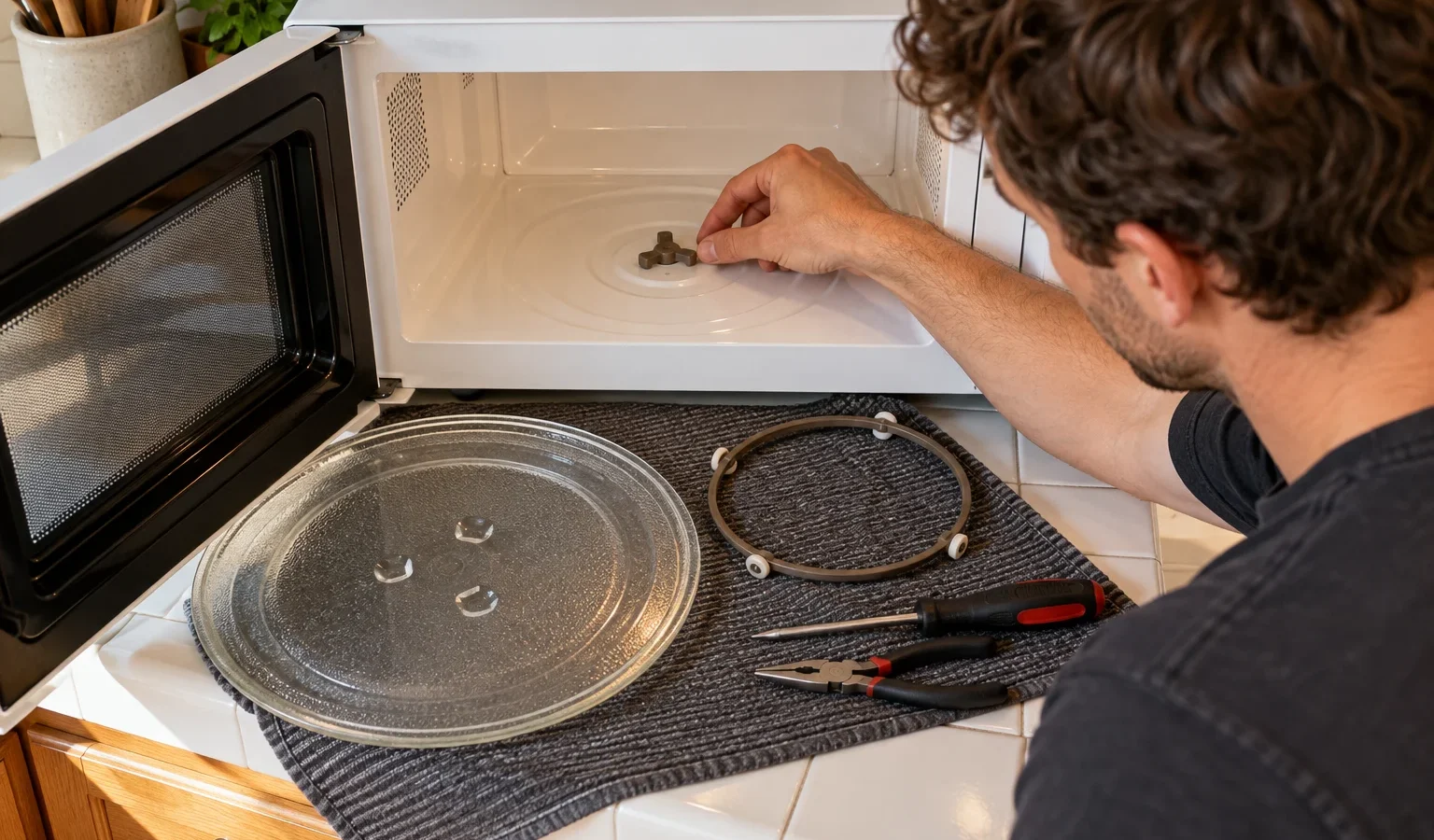
The turntable in a microwave is a simple mechanical system, and most failures are mechanical too. A glass plate rests on a ring with small wheels, and the ring rides over a hub in the floor of the cavity that is turned by a motor underneath. When any link in that chain is out of place, the plate stops, jerks or rattles.
Because the parts are removable and the cavity is designed to be wiped out, this is one of the few microwave problems where an owner can learn a lot before calling. It is worth ten minutes, particularly in a small San Francisco kitchen where the microwave works hard every day.
Lift the glass tray out and look at the underside. The center has molded lugs that must mate with the coupler on the floor. If the plate is chipped, cracked or worn around those lugs, it will not engage. A cracked plate should be replaced rather than used, since it can break while hot.
Wash the plate and dry it, then place it back with the underside lugs aligned. A plate that sits slightly crooked may turn for a moment and then slip. Rotate it by hand while seated to feel for a catch.
The roller ring is the plastic ring with wheels that sits under the plate. Remove it and check that every wheel spins freely and that the ring is not warped or cracked. Spilled sugar, soup or grease on the cavity floor will gum up the wheels and the track they run on.
Wipe the floor under the ring with a damp cloth, taking care not to push liquid into the center hub. Put the ring back so its wheels sit in the track, and make sure it sits flat. If a wheel is missing or the ring is bent, the plate will tilt and stall.
The coupler is the small star-shaped or flat-ended piece in the center of the floor. It slots onto the motor shaft underneath. If it has worn smooth or cracked, it will spin without turning the plate. Gently check that it sits fully down and is not loose, but do not pry. If the coupler spins freely and the plate does not move, the coupler may need replacement.
An oversized dish or a cup that hits the cavity wall can stop a plate from rotating. Overloaded or off-center items put load on the motor and can slip the coupler. Test with a single light item, such as a mug of water, centered on the plate. Never run the microwave empty.
If the plate, ring and coupler are clean and seated and the turntable still will not turn, the motor beneath the cavity floor may have failed. Reaching it means opening the cabinet, which exposes high-voltage components that hold dangerous charge even when unplugged. That is technician-only work. A motor that hums but does not move the plate, or one that is silent while the unit cooks, tells us which side of the microwave to look at.
Over-the-range microwaves are common above gas and electric ranges in San Francisco flats. Heat and grease from the range below find their way into the cavity vents and onto the floor. Keep the grease filters clean and the vent openings clear, and wipe splatter on the cavity floor promptly. If the unit shares its space with a ducted hood, a heavy plate or a tilted mounting can add stress.
Once the turntable is moving again, a short habit keeps it that way. Lift the plate and ring out of the cavity after messy cooking, rinse both, dry them, and wipe the floor before putting everything back. Always cover liquids so they do not boil over into the track. In shared apartments or rentals where several people use one microwave, put the roller ring back wheel-side down every time; a ring dropped in upside down is a surprisingly common reason a plate stalls.
If the microwave also fails to heat, read about a Whirlpool microwave not heating. In our library, WML75011HZ is an over-the-range low profile microwave and WMH32519HZ is an over-the-range steam microwave. The model label is usually inside the cavity on the door frame or side wall; our guide to finding a Whirlpool model number shows the usual spots.
Read the full overview at Whirlpool microwave repair and the lineup at Whirlpool microwaves. We diagnose first, give a written estimate, and do not repair anything until you approve it.
Not usually. The microwave still cooks, but food heats unevenly. Stop using it if the plate is cracked or if you see sparks or smell burning.
Yes, those parts are removable and are safe to swap. If a clean, seated plate still will not turn, the coupler or motor may be at fault.
A worn coupler, a warped ring or an overloaded dish can slip under load. The plate turns when lightly loaded and stalls when heavy.
Dried food in the roller track or a broken wheel in the ring is the usual cause. Clean the floor and ring and check the wheels spin freely.
No. The cabinet houses components that hold dangerous charge. Leave that to a technician.
Share a few details and we’ll confirm an appointment. Prefer to talk? Call us and we’ll help right away.