

Specialized Whirlpool Appliance Repair in San Francisco
Mon–Sat: 8:00 AM – 7:00 PM
A dishwasher that runs with little or no water is usually waiting on the supply, the fill valve or a sensor. Check the valve and line first, then the codes.
You start a cycle and hear the pump hum, but the tub stays dry or only a splash of water appears. Sometimes there is a hiss of water and then silence; sometimes the dishwasher stops and flashes a code. Water in a dishwasher has to be requested by the control, delivered by the household supply, admitted by a valve and confirmed by a sensor. If any link is missing, the tub does not fill.
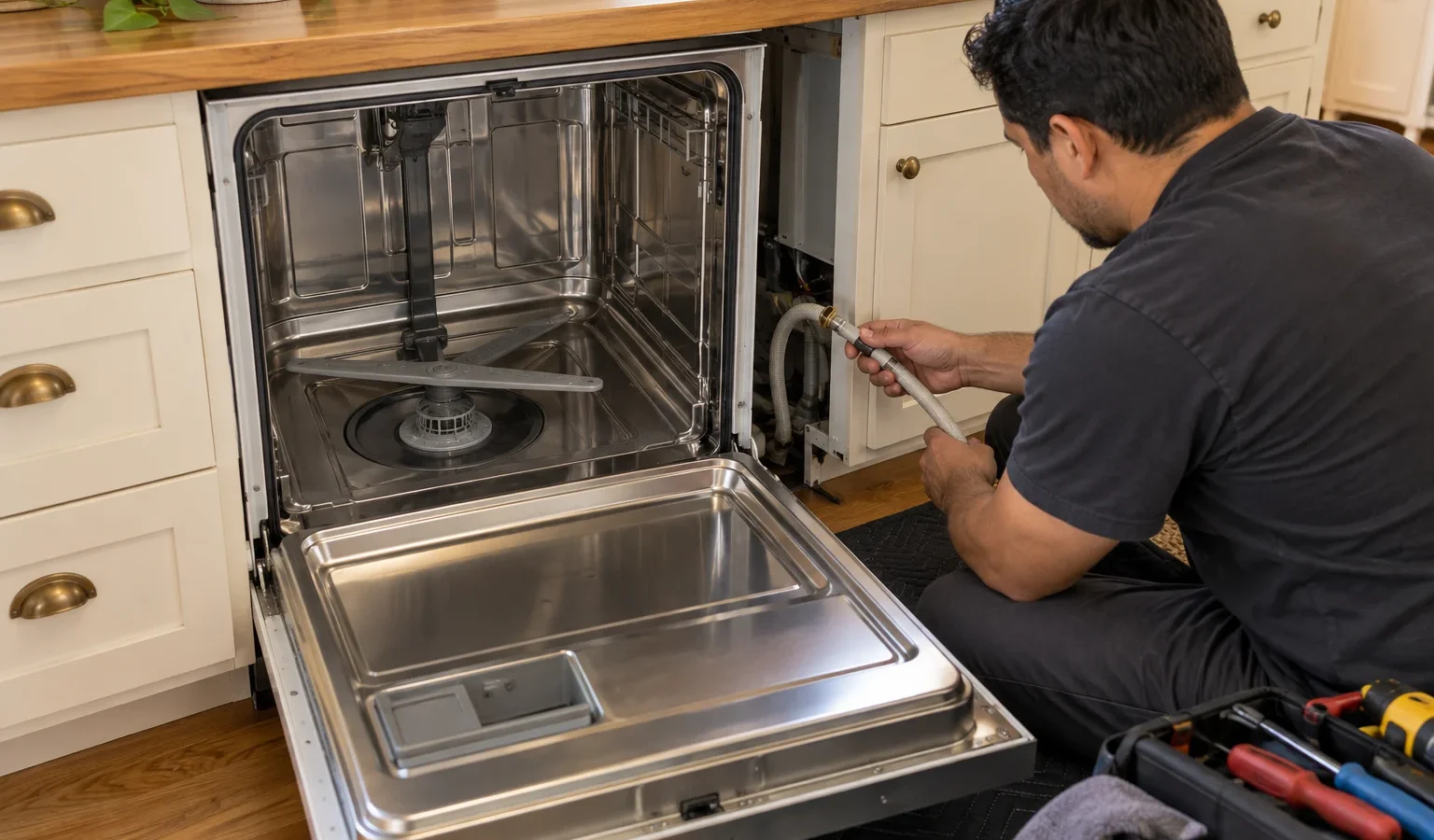
The household supply line runs from a shutoff valve under the sink to the dishwasher, where an inlet valve opens when the control calls for water. The water flows into the tub until a sensor, such as a float or a pressure switch, reports the right level. A closed door and latch also tell the control that it is safe to fill. When one of these steps does not happen, the cycle may start and stop, run dry or end early.
Each one tells you where the control saw a problem, not which part has failed. A stuck-open valve and a failed valve call for opposite actions, so please do not guess.
If the dishwasher fills when it is not running, or you see water rising in the tub, close the shutoff valve under the sink right away. Do not run the dishwasher. If the display shows a protection code that tells you to turn off the water supply, do that, then switch off the dishwasher at its breaker or unplug it. Dry any water on the floor and keep it clear of the outlet. A valve that sticks open can overflow the tub and damage the cabinet and floors, which matters in upper-floor flats.
Under-sink space in San Francisco kitchens is often shared with a garbage disposer, filters and storage. Supply lines get crushed when boxes are pushed against them. An installer who set the line at a sharp angle leaves a kink that restricts flow. If the dishwasher was recently moved or the area under the sink was reorganized, look there first. A shutoff valve that is old and stiff may be only partly open even when the handle seems to be at the open position.
Book when the supply and valve are open, the line is straight, the door closes and the dishwasher still does not fill, when a fill-related code returns, or when water leaks or fills on its own. A technician checks the valve, the screen, the sensor and the control signal. Have the model number ready, usually found on the door edge or tub rim, and describe what you heard and saw. Diagnosis comes before repair, the estimate is written and nothing is fixed without your approval.
See Whirlpool dishwasher repair and the Whirlpool dishwashers page. The Whirlpool GU3000XTXQ page covers a Whirlpool Gold dishwasher that is no longer sold new.
The supply may be off, the line kinked, the fill valve not opening or a sensor not confirming the level. Begin with the shutoff valve and supply line.
It is listed with a potential cause of not detecting water. It points toward the fill side rather than the drain.
Yes. A fill valve stuck open can let water in when the dishwasher is idle. Close the shutoff valve and request service.
It can be. The control wants to know the door is closed before it admits water, so make sure the door latches firmly.
Yes. F8E4 instructs you to turn off the water supply. Close the valve under the sink, then request a visit.
Share a few details and we’ll confirm an appointment. Prefer to talk? Call us and we’ll help right away.