

Specialized Whirlpool Appliance Repair in San Francisco
Mon–Sat: 8:00 AM – 7:00 PM
Some clicks are the refrigerator doing its job, others signal a compressor that cannot start or a fan hitting ice. Learn the difference and what to write down for the technician.
Refrigerators are never silent. They tick, thump and hum as parts warm up, cool down and cycle on and off. In a small San Francisco apartment where the kitchen is a few steps from the bed, you notice every one of those sounds. The question is whether the click you hear is a harmless part of the cycle or the sound of something struggling.
A single click when the compressor starts or stops is common, and so is a soft tick as plastic liners expand and contract with temperature changes. A defrost cycle can produce a few clicks and a faint crackle as meltwater runs and warm parts settle. An ice maker that drops cubes into the bin makes its own rattle and clunk. None of those need attention if the refrigerator is cold, the sounds are occasional and the cycle repeats normally.
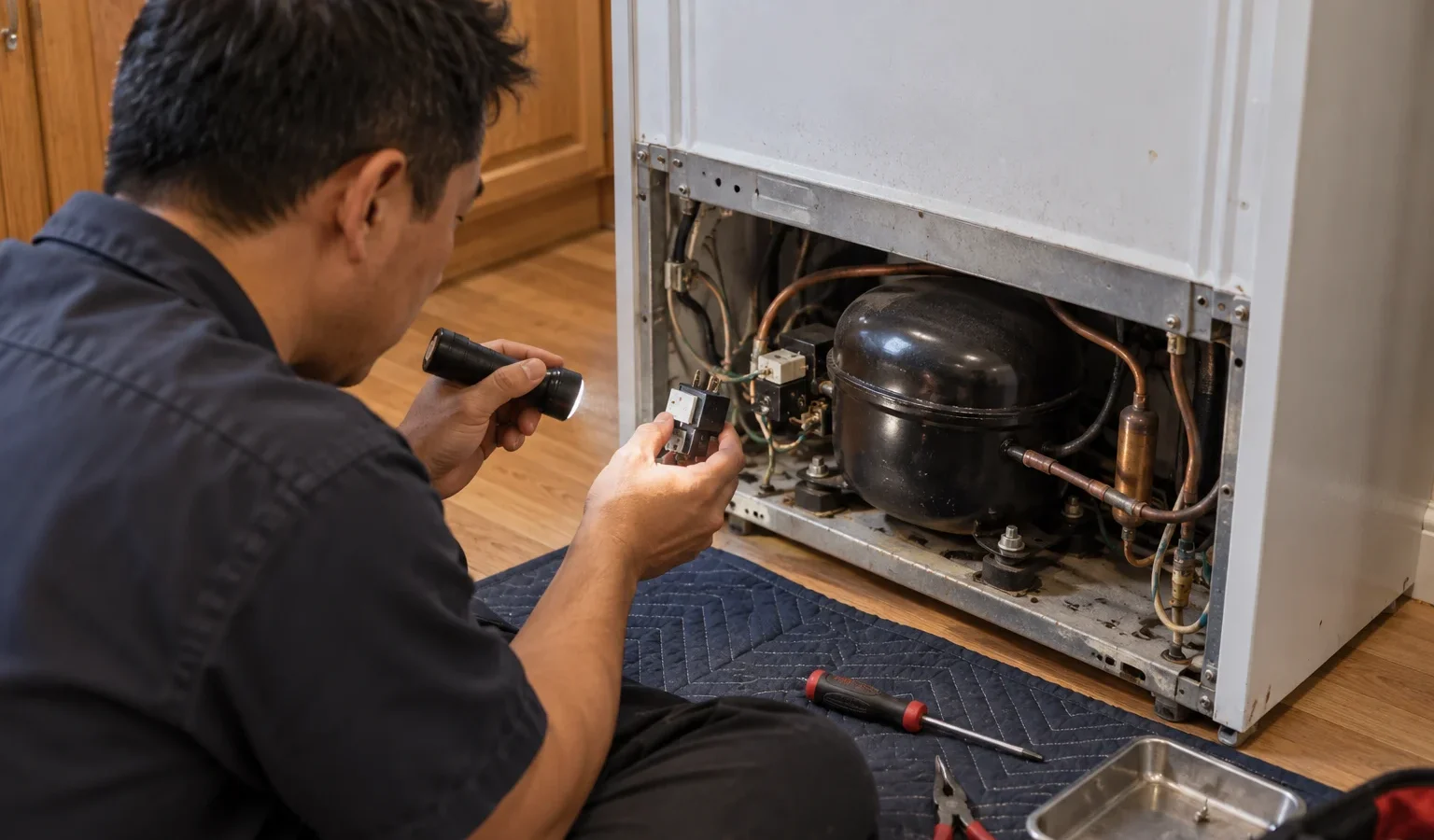
From the bottom rear. This is where the compressor, its start components and the condenser fan live. A rhythm of click, hum, silence is the classic sign of a start problem. A rattling can also come from a loose drain pan or a fan with a bent blade.
From inside the freezer. Behind the back panel is the evaporator fan. If frost has grown around it, the blades hit ice and make an irregular tapping. That frost points to a defrost fault, which also leads to warm food.
From the door or the upper area. The ice maker’s ejector, a water valve and a dispenser flap all click. If production stalls too, read the ice maker article.
From the control or display. Relays on the board click when they switch loads. A relay that chatters repeatedly while the refrigerator is not behaving normally can point to a control issue, which only a technician can test.
One controlled power reset can sometimes settle a control that behaved oddly after a building power flicker. If the clicking returns, repeating resets will not help and may stress the compressor.
In a rental, a clicking refrigerator is often reported by the tenant long before anything is visibly wrong. Ask the tenant to write down when the sound happens and whether the food is still cold. A building that has several Whirlpool refrigerators from different years can make the same click for different reasons, so the model number and a short sound description are more useful than the word “noisy”.
Ask for a visit when the clicking repeats, when the freezer sounds like ice is being struck, when cooling is weak, or when the sound arrives with an odd smell. Tell us when the sound began, whether a power interruption happened first, and what the display shows. The model number, usually on the inside wall or around the door frame, helps us plan.
The visit starts with diagnosis, then a written estimate, and no repair goes ahead without your approval. Details are on Whirlpool refrigerator repair and in the Whirlpool refrigerators guide. Owners of a bottom-freezer unit like the Whirlpool WRFF3336SB can also see that model page.
Yes. A single click at the end of a cooling cycle is a normal sound on many refrigerators. It is repeated clicking that never leads to steady running that needs checking.
A fan may be striking frost or a loose part may be shaking against the cabinet. Frost near the fan suggests a defrost problem, so food temperature matters here.
It can, particularly when the click is followed by a hum and silence on repeat. The cause might also be a start component rather than the compressor, which is why the unit needs testing before any part is replaced.
If food is warm and the compressor is clearly not running, unplug it to avoid repeated start attempts and move perishables to a cooler. Then request a visit.
It can. The ice maker clicks and clunks when it cycles and drops cubes, and the water valve clicks when it opens. Those sounds are normal unless ice or water stops.
Share a few details and we’ll confirm an appointment. Prefer to talk? Call us and we’ll help right away.