

Specialized Whirlpool Appliance Repair in San Francisco
Mon–Sat: 8:00 AM – 7:00 PM
Your Whirlpool washer fills and sloshes but the drum never reaches a real spin, and the clothes come out soaked. Here is how to sort out the cause before you book a visit.
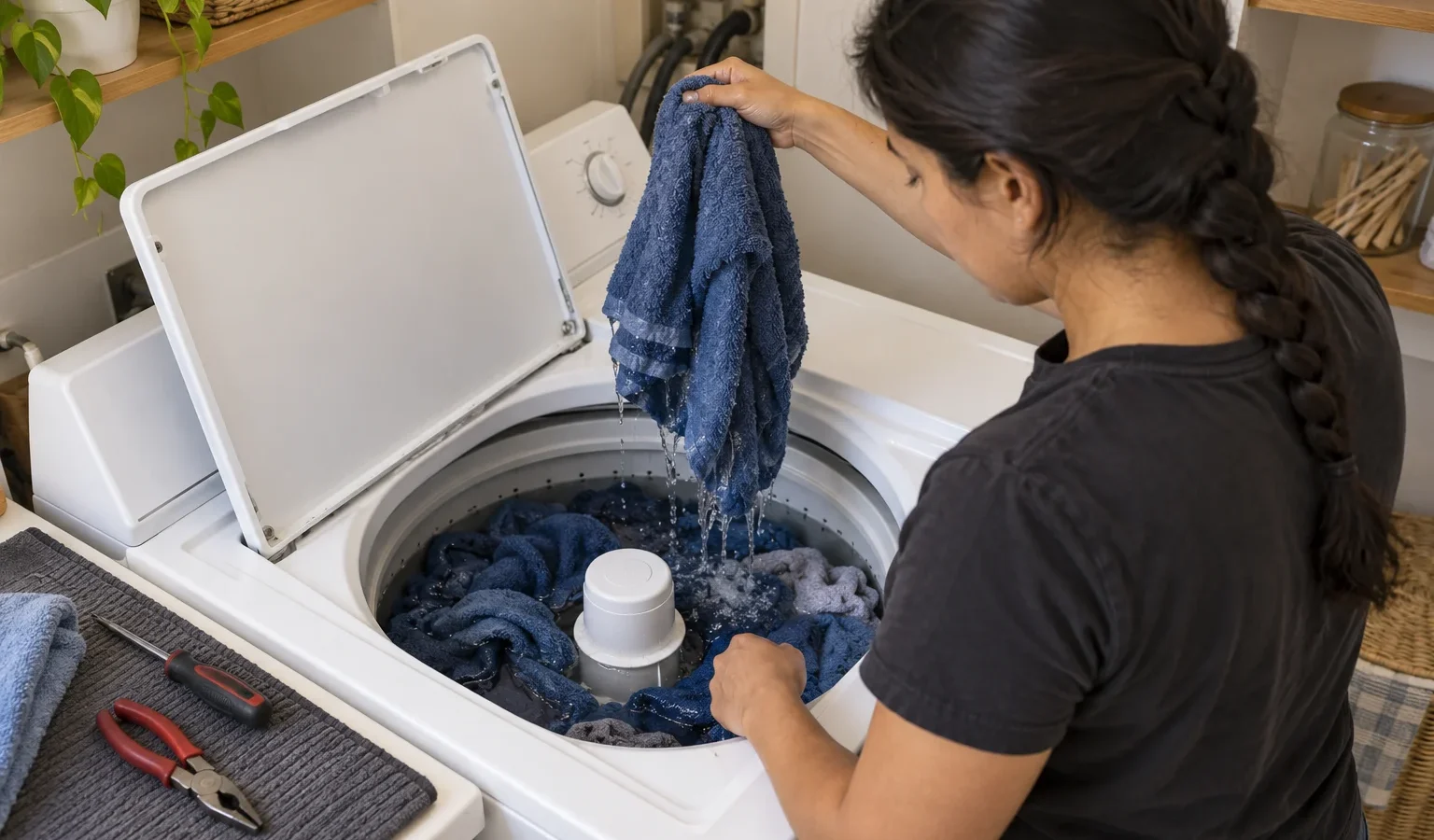
You open the lid or door and find a drum of dripping, heavy clothes. The wash seemed fine, but the spin never took hold, or it started and quit. In a San Francisco flat with the washer in a hallway closet, this is when people start mopping and searching.
The washer decides whether to spin from several conditions at once: a closed and locked lid or door, an empty tub, a load it can balance, and a drive system that can turn the basket. Finding which one failed is most of the repair.
Different failures look different, so watch before touching anything.
A washer will not spin a tub full of water. If the drain is slow or blocked, the machine holds off. Look through the lid or glass for standing water; if it is there, read our guide to a Whirlpool washer that won’t drain.
The washer code library has entries that match this situation. The code F0E8 is described as too much residual water detected in the washer, which fits a spin that was held back for exactly this reason.
Top-load washers rely on a lid switch, and front-load washers on a door lock. If the lid has been propped, if a sleeve or sock is caught under the edge, or if the striker no longer lines up, the washer treats the cycle as unsafe to spin. A quick check takes seconds: open the lid fully, make sure nothing is in the way of the edge, and close it firmly. Listen for the click on a front-load door.
If a code points at the lid, the washer library lists LdL as an item in the load that may be keeping the lid from locking. That is a loading problem you can fix yourself by moving the item and closing the lid again.
A washer that senses lumps will rebalance, pause and sometimes quit before the spin finishes. One heavy rug or a handful of jeans with towels can do it. Mix heavy and light items by hand and run the spin again.
Two library entries are worth knowing here. uL describes an off-balance load that needs to be redistributed manually, and oL says the load is too large. If you see either, taking some items out and trying again is the right first move. If it keeps happening with small, mixed loads, the problem is no longer the laundry. Our companion article on a washer that is off balance explains the other angles.
If the lid is closing, the tub is empty and the load is small and mixed, but the basket still will not turn, the cause sits deeper. A technician looks at the parts that connect the motor to the basket, the motor itself, the signal that tells the washer how fast the basket is turning, and the control that coordinates all of it. Some top-load washers use a coupling between motor and transmission, and wear there can leave the motor running with nothing to turn.
Panels hide live wiring and heavy moving parts, so this part is for the visit. What helps is noting the sound, whether the basket turns by hand with the power off, and any code.
Several codes in the library involve the control or wiring on top-load washers, such as F7E0, F6E2 and F2E3. The library describes the control-related ones as an issue with the control unit, user interface or associated wiring, and a few have only reset steps and no stated cause. Treat them as clues for the technician, not as a verdict on a part.
Work down this list from the outside only.
Do not reach into a moving drum, force a locked lid, or work on the washer with the power connected. If you smell burning or see sparks, switch it off at the breaker and leave it off.
In a stacked or closet laundry, hoses get pinched when the washer is pushed back, and a pinched drain hose is a common reason for a tub that never empties. Our washer repair service covers closet, stacked, top-load and front-load setups, and the Whirlpool washer lineup page explains where to find your model label.
If your washer is a listed top-load unit such as the WTW5010LW or the Cabrio top-load WTW6400SW, the checks above still apply. For the front-load WFW5620HW, which is no longer sold new, pay extra attention to the door and the drain.
Book when the basket will not turn with a small mixed load, when a code returns after a power reset, when the washer hums without moving, or when you hear grinding. The visit starts with a diagnosis before any repair. You get a written estimate, and nothing is repaired until you approve it. Having the model number and the code ready speeds that up.
Usually the washer is holding back the spin for a reason: water still in the tub, a lid or door that is not registering closed, or a load it cannot balance. If none of those apply, a technician checks the drive parts between the motor and the basket.
Yes. One rug or bath mat soaked with water makes the washer pause and rebalance, and sometimes quit. Remove it, mix the remaining items and restart the spin.
Not by itself. A code points the technician toward a system such as the lid lock, drain or control. The visit confirms what actually failed before anything is replaced.
Your model number, the exact code shown, what the drum did, and whether there was standing water. A photo of the label inside the lid or on the cabinet helps.
Share a few details and we’ll confirm an appointment. Prefer to talk? Call us and we’ll help right away.