

Specialized Whirlpool Appliance Repair in San Francisco
Mon–Sat: 8:00 AM – 7:00 PM
Water stays in the tub after the cycle and the clothes sit in a cold puddle. Work through the hose, standpipe, filter and pump in the right order to find where it is stuck.
The cycle ends, the lid releases, and you look down at a tub of gray water. The washer did not empty, so it never spun, and every sock is wet. In a San Francisco building with a shared drain stack, it is natural to wonder whether the washer or the building is at fault. The honest answer is that either can be, and a methodical order of checks tells you which.
Draining is a chain: the washer pump pushes water out, the drain hose carries it up and over, the standpipe or sink connection takes it, and the building drain accepts it. A break at any link looks the same from the tub. The trick is to start at the outer end and work inward, because the easiest checks sit there.
Look at the standpipe, the pipe behind the washer where the drain hose is inserted. If water has backed up in it, or if it gurgles when the washer pumps, the restriction is downstream of the washer. A partly clogged building line, a lint-packed standpipe, or a hose pushed in too tightly can make the water struggle to leave.
If you rent, tell the manager before attempting anything beyond lifting the hose out and looking. Clearing a shared line is not an owner job in most buildings.
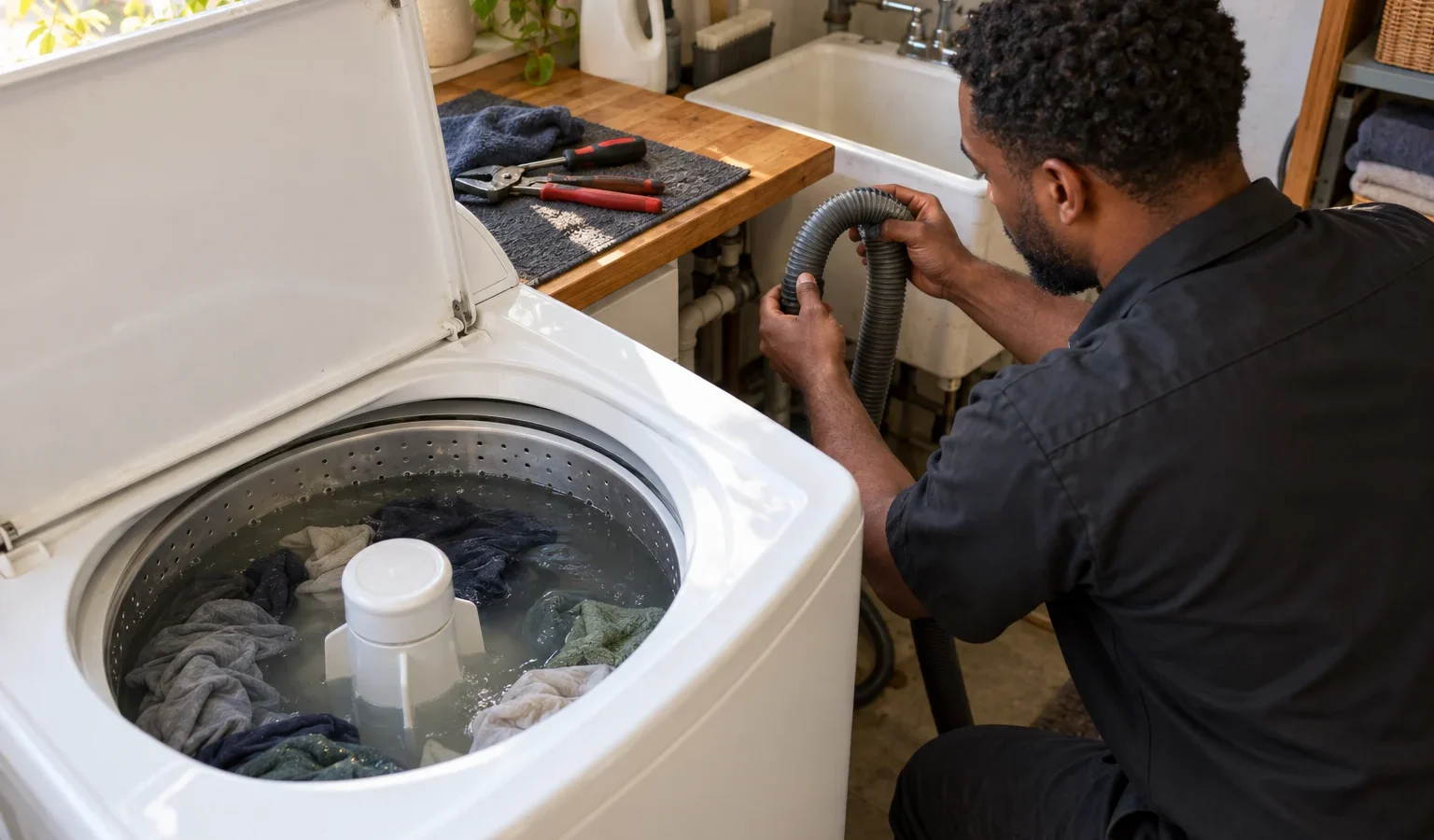
The drain hose runs from the washer to the standpipe, often with a bend or loop to prevent siphoning. Common problems are a kink where the washer was pushed against the wall, a hose crushed under a stacked dryer’s weight, and lint or a sock lodged inside. Gently pull the washer out only as far as the hose allows, look for kinks, and straighten what you can. Do not strain the hose or disconnect it with water in the tub unless you are ready for a flood; put a shallow pan and towels under the connection first.
Most front-load washers have a drain filter behind a small door at the bottom front. Coins, hair ties, pocket debris and lint collect there and keep the pump from pulling water. Cleaning it is a normal owner task. Place a flat container and towels in front, open the filter slowly, let the water come out, remove debris, and reseat the filter fully. A filter that is not seated can leak or throw a drain code. Our companion article on front-load washer smell explains why this filter is also worth cleaning for odor.
Top-load washers do not have an owner-accessible filter in most cases. If the hose and standpipe are clear and the tub still holds water, the problem is probably in the pump, a blockage inside the pump housing, or a control or sensor that does not tell the pump to run. The library describes drn and Ld as a washer taking too long to drain, and F0E8 as too much residual water detected.
Beyond top-load entries, the library gives clear drain-related entries for other types.
A code only names a place to look. A kinked hose and a failed pump can both produce the same entry, which is why checking the outside first is not wasted effort.
Do not run additional cycles hoping it will clear, because every new fill adds water you will have to deal with. Do not use chemical drain cleaners in the standpipe or the washer, as they can damage seals and put fumes in a small laundry closet. Do not open panels or work around the pump with the power connected. If you smell burning or hear a loud grinding, switch the washer off at the breaker.
If the tub is full, bail out water with a cup into a bucket before reaching into the washer, and keep towels ready. Never reach into water near a plugged-in appliance with wet hands; unplug first.
Stacked and closet washers sit close to walls, and a dryer above can add weight to the hose when the washer is pushed back. In older Bay Area buildings the standpipe may be shared or shallow, and some washers drain into a utility sink instead. These details change where the restriction is. Our washer repair service covers those installations, and the Whirlpool washers guide explains where to find the model label to bring to the call.
For listed models such as the top-load WTW5105HW or the front-load WFW5620HW, which is no longer sold new, the same order of checks applies.
Book when the hose and standpipe are clear and the filter is clean but the water stays, when the pump hums without moving water, when a drain code returns after a reset, or when you notice leaking around the washer. A technician diagnoses first, gives you a written estimate, and repairs nothing until you approve it.
Either the pump cannot move the water or the washer does not know it should. A kinked hose, a clogged standpipe, a blocked filter or pump, and a control signal can all do it.
On a front-load washer with the power off, yes, if you place a container and towels first. Do not open other panels.
No. It does not help a hose or pump problem and it can harm seals and put fumes in a small closet.
If the standpipe fills or gurgles while the washer pumps, the restriction is likely past the washer. Tell your manager or a plumber instead of clearing a shared line.
The model number, any drain code, whether the filter was cleaned, and what the standpipe and hose looked like.
Share a few details and we’ll confirm an appointment. Prefer to talk? Call us and we’ll help right away.